
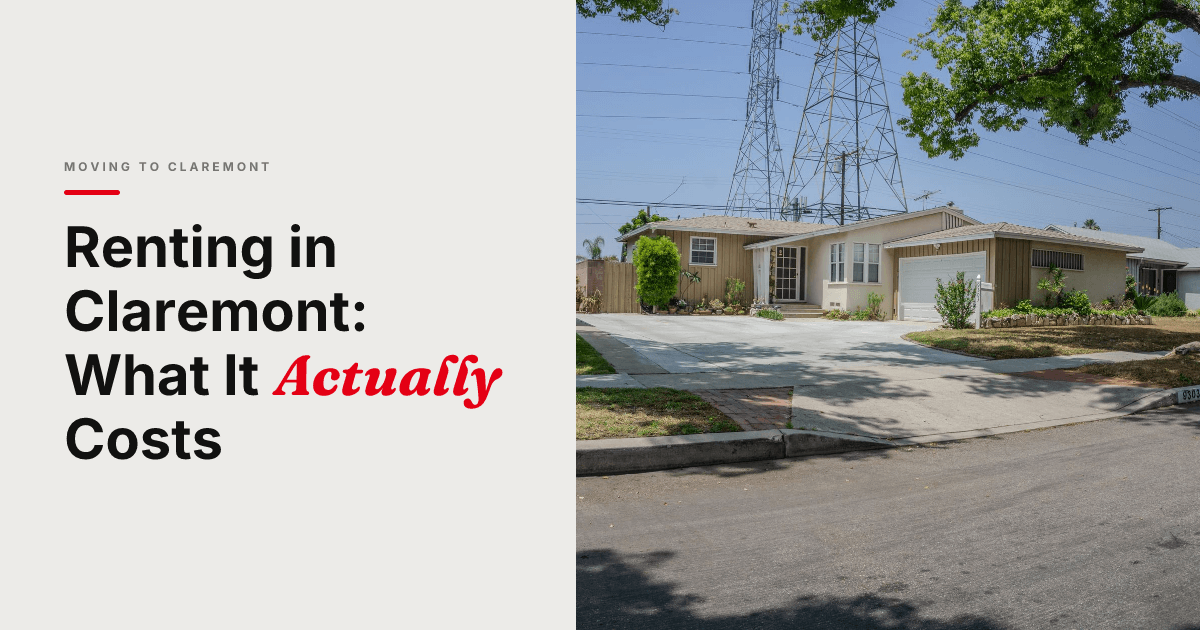
Renting in Claremont Before You Buy: Costs, Neighborhoods, and a 12-Month Plan
Rent first. If you are moving to Claremont CA from out of the area and you do not already know the difference between a block north of Base Line Road and a block south of the tracks, a twelve-month lease is the cheaper mistake. It is not a delay. Done deliberately, a year as a renter buys you neighborhood knowledge, a verified commute, a bigger down payment, and a lease that expires exactly when Claremont's inventory is at its best.
Here is the backdrop. Per Redfin's Claremont housing market page, updated July 2026, the median sale price in Claremont was $1.1 million, up 1.4% year over year, at $520 per square foot, and homes were selling in about 35 days, up from 26 days a year earlier. Per Freddie Mac's Primary Mortgage Market Survey for the week of August 6, 2026, the 30-year fixed averaged 6.69% and the 15-year averaged 6.01%. Those two numbers together mean a rushed purchase in Claremont is an expensive way to learn which street you actually want.
What renting in Claremont actually costs right now
Apartments and houses are two different markets here, and the gap is wide. Read one source and you will get the wrong picture, because each platform samples a different slice of the stock. Anyone moving to Claremont CA should check all three before setting a budget.
Source (as read)Studio1 bed2 bed3 bedOverall
RentCafe, Aug 2, 2026
n/a
$1,788
$2,481
n/a
$2,113 average
Zumper, Aug 10, 2026
$1,909
$2,097
$2,495
$3,350
$3,157 median
Apartments.com, Aug 2026
n/a
n/a
n/a
n/a
$1,897 average
RentCafe's numbers are apartments only. Its August 2, 2026 update had the average apartment rent up 1.62% from $2,079 a year earlier, with one-bedrooms averaging 652 square feet, two-bedrooms 918 square feet, and the average unit 747 square feet. RentCafe also reports that the largest share of Claremont rentals falls between $1,501 and $2,000 a month, and that renters make up 37% of households here.
Zumper runs higher because its sample includes houses. Read on August 10, 2026, it had the all-bedroom median down 8% month over month and down 1% year over year.
Apartments.com sits at the low end, up 0.9% over the prior year — about $18 more a month. That figure leans on the smaller apartment stock and is not a useful number if you need a yard.
Read all three together and the practical picture is this. A couple or a single professional can rent in Claremont in the low $2,000s. A family that needs three bedrooms, a yard, and a garage should plan around Zumper's $3,350 three-bedroom median, with the top of the single-family rental market running well past it.
Treat the month-to-month swings as noise. Zumper had one-bedrooms up 10% year over year in the same reading where two-bedrooms were down 8%. Those are not two opposing trends. That is a small city with a thin sample, and it is why you should shop the actual listings rather than the index.
Budget beyond the rent itself. Under AB 12, effective July 1, 2024, California caps most security deposits at one month's rent, and pet and cleaning deposits fold into that cap. Small landlords who own no more than two residential properties totaling four or fewer units may still collect two months. Run that on Zumper's $3,350 three-bedroom median: first month plus a one-month deposit is $6,700 due at signing. If your landlord qualifies for the small-owner exception, it is $10,050. Ask which one you are dealing with before you fall for a house.
Rent by micro-area: the Village, North Claremont, Claraboya, and south of the tracks
No platform publishes rent by Claremont neighborhood. RentCafe, Zumper, and Apartments.com all report citywide. What follows is directional: how each area sits relative to those citywide figures, based on what the housing stock in each area is and what actually turns over there.
Claremont Village
The Village is the smallest-unit, highest-turnover rental market in the city. Think older fourplexes and duplexes on the side streets off Yale Avenue and Harvard Avenue, converted second units, and a handful of newer apartments in Village West near the Laemmle. You can walk to Some Crust Bakery on Yale, the Sunday farmers market on Harvard, the Packing House at 532 W. First Street, and the Metrolink depot at 200 W. First Street. You are paying for that. Expect one and two bedrooms at or above the citywide medians, and expect very few three-bedroom houses to ever come up. Rent here if you want to test whether in-town living is worth the premium before you pay a buying premium for it.
North Claremont
North of Foothill Boulevard, running up toward Base Line Road and Mountain Avenue, the stock is mostly single-family tract homes from the 1960s and 1970s on larger lots. Rentals are almost entirely owner-held houses, so supply is thin and listings go fast. This is where Zumper's $3,350 three-bedroom median and $3,157 all-bedroom median are the most relevant numbers on the page. It is also the area most families are ultimately trying to buy in, which makes it the highest-value place to spend a rental year: you learn the school assignment, the Thompson Creek Trail access, and the actual morning traffic on Mountain before you commit seven figures.
Claraboya and the foothill streets
Above Padua Avenue, the hillside streets are view lots, custom homes, and steep driveways. Rentals here are rare and usually one-off: an owner relocating for a year, an estate holding a property. When one appears it prices as a luxury rental, not a market rental. Do not build a twelve-month plan around finding one. Do drive these streets on a weekday evening and a Saturday morning while you rent elsewhere, because the commute out of the foothills is a real factor most buyers underestimate.
South of the tracks
South of the Metrolink line, toward Arrow Highway and the Arbol Verde area, the housing is older and smaller and the apartment supply is deeper. This is where Claremont's cheapest units mostly live, at or under RentCafe's $1,788 one-bedroom average. It is the most affordable way to establish a Claremont address, and an address matters if school enrollment is part of your reason for moving. Verify boundaries with Claremont Unified directly rather than trusting a listing site's school tag.
One more timing note on supply. The Claremont Colleges reset a chunk of the local rental market every August. If you are hunting in July and August, you are competing with students, visiting faculty, and staff. Hunt in a different month if you can.
Claremont's price-to-rent ratio explains why the first year should be a lease
Divide Redfin's $1.1 million median sale price by twelve months of Zumper's $3,350 three-bedroom median and you get a price-to-rent ratio of roughly 27. That is my own arithmetic from two published figures, so treat it as directional rather than as an index. It also sets a citywide sale median against a citywide rent median, which is a blunt comparison. The conventional read on a ratio in the twenties is that renting wins on a short horizon and buying only wins over a long hold.
Run the ownership side and it holds up. On that $1.1 million median with 20% down, an $880,000 loan at Freddie Mac's 6.69% average works out to about $5,670 a month in principal and interest. Add property taxes, which under Proposition 13 start at 1% of assessed value plus voter-approved levies, and you are adding roughly $920 a month. Call it $6,600 before insurance, against $3,350 to rent a comparable three-bedroom house. That is a gap of about $3,250 a month.
That spread is not an argument against buying in Claremont. It is an argument against buying in Claremont in your first ninety days, with an unverified commute, a school assignment you have not confirmed, and a down payment you are stretching to make. The gap between renting and owning here is large enough to fund a meaningfully better purchase twelve months later.
Lease timing is the lever most people moving to Claremont CA get wrong
Sign a lease that ends in late February, March, or April.
Claremont's for-sale inventory builds through late winter and peaks in spring, the same pattern as the broader Los Angeles County market. Sellers who sat out the holidays list in February and March. That is when you want to be liquid, pre-approved, and free to move, not eight months into a lease with a penalty for leaving.
The mechanics are simple, and you negotiate them at signing, not later:
- Ask for an end date, not a duration. A "13-month lease ending March 31" is a normal request and most Claremont landlords will take it over a vacancy.
- Get a month-to-month rollover in writing. You want the option to hold over at a stated rate if escrow runs long, without signing a fresh year.
- Negotiate a lease-break clause up front. Sixty days' notice plus a fixed fee is far cheaper than a dispute in month nine.
- Confirm who owns the property. Under AB 1482, single-family homes and condos owned by individuals are exempt from the state rent cap when the owner gives proper written notice. Corporate-owned and multi-unit properties generally are not.
- Know the cap that applies. Where AB 1482 covers the unit, annual increases are limited to 5% plus CPI or 10%, whichever is lower. Los Angeles County's Department of Consumer and Business Affairs publishes the current figures.
Avoid an August expiration. That is the month the college rental market resets and the month the for-sale market is at its thinnest and most picked-over.
What twelve months as a Claremont renter does to your buyer profile
A year here changes what kind of buyer you are, in ways that show up in the price you pay.
You learn the streets at the block level. You find out that a house two blocks from Indian Hill Boulevard sounds different at 7 a.m. than it did during your Sunday showing. You watch specific listings come and go and you build a real sense of what over-priced looks like in this city, which matters when Redfin says the median home takes 35 days but the well-priced ones go pending in around 22.
You verify the commute instead of estimating it. The Metrolink San Bernardino Line serves the 1927 Santa Fe depot at 200 W. First Street throughout the weekday, in both directions. Metro's A Line reached Pomona on September 19, 2025; per the Foothill Gold Line Construction Authority, major construction on the segment to Claremont is expected to begin as early as late 2027 and take roughly four years. If your plan depends on rail, rent near the depot for a year and find out whether you actually use it.
You get your school questions answered by the district, not by a listing. You bank the difference between renting and owning. And you build a relationship with a local agent well before you are under pressure, which means when the right house lists on a Thursday you are not still choosing who to call.
The 12-month plan for moving to Claremont CA, from arrival to keys
Work backward from a spring close.
Months 1 and 2 — land and observe. Move in. Do not tour a single for-sale home. Drive the four micro-areas on weekdays and weekends. Register kids and confirm the school assignment with Claremont Unified.
Months 3 and 4 — set the financial floor. Meet a lender and get a full pre-approval, not a rate quote. Establish your true budget range including taxes and insurance. Automate the savings transfer that closes your down payment gap.
Months 5 and 6 — narrow to two areas. Pick your non-negotiable: lot size, in-town access, school, or view. Shed the areas that fail it. Start attending open houses in your two survivors, every weekend, without intent to buy.
Months 7 and 8 — build the file. Choose your agent. Set up alerts on your two target areas. Learn what each street's realistic price band looks like by tracking closed sales, not asking prices.
Months 9 and 10 — get transaction-ready. Refresh the pre-approval. Line up your inspector and your insurance quotes now, because California insurance timelines near the foothills can be slow. Give notice or confirm your rollover terms with the landlord.
Months 11 and 12 — buy. New inventory is arriving. You have seen these blocks in every season. Write with a short contingency window because you already did the homework, and close as the lease ends so you move once.
When renting first is the wrong call
Be honest about the cases where this plan is a waste of money. Not everyone moving to Claremont CA should rent first.
If you already know Claremont and know your street, rent nothing. If you are a cash buyer, the price-to-rent math is irrelevant to you and you should buy the right house when it appears. If your employer is paying relocation on a fixed clock, take the certainty. And if you are moving from another Los Angeles County city with school-age kids mid-year, a double move can cost more in disruption than it saves in dollars.
Renting also costs you something real: a year of rent you do not get back, and exposure to whatever prices do in the meantime. Redfin has Claremont up 1.4% year over year as of July 2026, which is mild. If that pace accelerated, a year of waiting would get more expensive. Nobody can tell you which way that goes. What I can tell you is that buying the wrong Claremont block costs far more than one year of appreciation.
If you want that decision pressure-tested against your actual numbers and timeline, reach out to Mr. Claremont™ for a one-on-one consultation. Bring your lease dates and your pre-approval, and we can build the calendar backward from there.
Anthony Grynchal is a licensed California real estate agent (DRE #01873626) affiliated with eXp Realty and publishes under the Mr. Claremont Real Estate™ brand. He is the founder and CEO of MetaDLE™ Technologies, which operates the Designated Local Expert™ / UCI Coin™ products referenced in some posts. Articles are informational and are not legal, tax, or financial advice; market figures change and should be verified against current data before acting.
Frequently asked questions
Can I break my Claremont lease early if my offer gets accepted?
Only on the terms in your lease. California landlords must make reasonable efforts to re-rent, which limits your exposure, but that is not the same as a clean exit. Negotiate a written lease-break clause at signing with a defined notice period and a fixed fee. It costs nothing to ask before you sign and it is nearly impossible to add once you have moved in.
Does a Claremont rental address guarantee my child a spot at a specific school?
No. Residency establishes eligibility within Claremont Unified, but individual school assignment depends on attendance boundaries and available capacity, and boundaries can be adjusted. Confirm the assignment for your exact address with the district before you sign a lease, and again before you write an offer. School tags on listing sites are frequently out of date.
What can a landlord charge for pets under the current California rules?
Since AB 12 took effect July 1, 2024, pet deposits count inside the one-month security deposit cap for most landlords. Monthly pet rent is treated separately and is still permitted. So a landlord cannot ask for an extra $500 pet deposit on top of a full month's deposit, but can charge ongoing pet rent. Get both figures in writing.
Does paying rent on time help my mortgage approval?
It can. Fannie Mae's Desktop Underwriter has considered positive rent payment history in its risk assessment since 2021, using bank statement data with the borrower's permission. Pay by a traceable method every month from the same account. Cash or hand-written checks leave no record your lender can use, which wastes twelve months of on-time payments.
Is renting in Claremont cheaper than nearby cities?
Per RentCafe's August 2, 2026 data, Claremont's $2,113 average apartment rent came in below Pomona at $2,239, Upland at $2,279, and Rancho Cucamonga at $2,579. That runs against most people's assumption. On the apartment side, renting in Claremont while you shop is not the premium option, even though buying here is.