
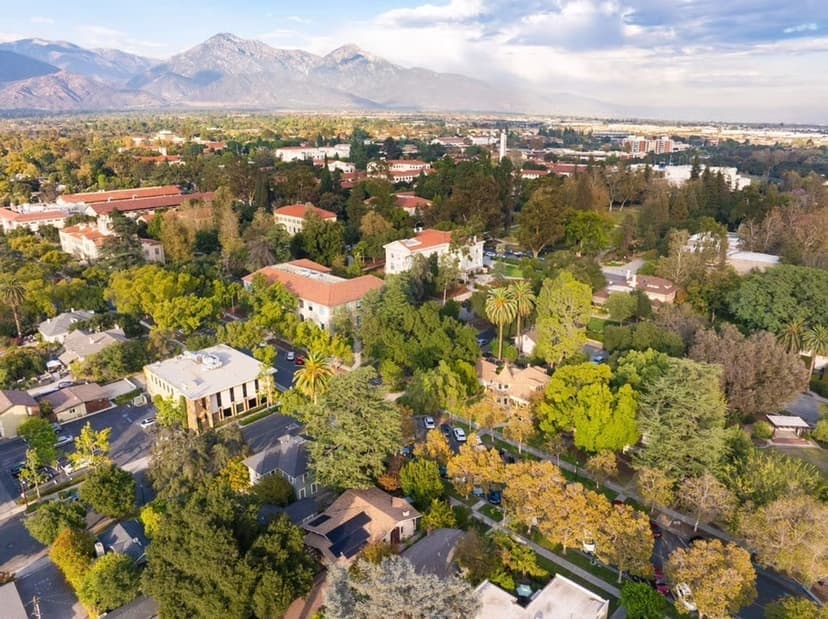
Every economy has an engine, and Claremont's sits in plain sight across its northeast quadrant: the consortium of colleges whose economic role in the town is easy to sense and worth understanding precisely. This article maps HOW an academic engine actually powers a local economy — the channels, not the numbers, because the channels are durable and the numbers belong to current reports — and why the engine's defining trait, steadiness, matters more to homeowners than its size. It deepens the local-economy guide's pattern; the story of how the engine got here is the history cluster's founding chapter.
Channel one: the payroll
The consortium is, structurally, one of the town's dominant employers — faculty across the institutions, and the larger iceberg beneath: administration, facilities, dining, libraries, IT, grounds, security, and the consortium's shared central services. Academic payrolls have two properties that shape a housing market. They are STABLE — enrollment-driven institutions with endowments and century horizons do not run layoff cycles the way cyclical industries do — and they are LOCALIZED: a meaningful share of the people paid by the colleges want to live near them, which produces the faculty-and-staff demand stream the rental-demand guide maps and the owner-occupant buyer pool the college-adjacent guide banks on. The employment fine grain — headcounts, rankings among employers — belongs to current data; the structure is what an owner can rely on.
Channel two: the population the engine imports
Beyond payroll, the engine IMPORTS spenders on a schedule: thousands of students whose living costs flow into the town's economy, visiting families on the academic calendar's rhythm (move-in, family weekends, and the commencement crescendo the rhythm guide walks), conference and event visitors through the year, and the rotating academic population — visiting faculty, postdocs, researchers — who rent, dine, and live locally on appointment clocks. For the town's business ecosystem, this imported demand is base load: the Village's restaurants and shops serve a customer population far larger than the resident count suggests, which is a real part of why a town this size sustains a downtown this alive.
Channel three: the multiplier and the halo
The third channel is the quiet one: everything the institutions BUY (construction, maintenance, services, supplies — campuses are perpetual clients for the building trades), everything their employees spend locally, and the halo of enterprises that exist because the colleges do — from tutoring and academic services to the cultural economy around the consortium's public calendar. Add the institutional cousins that cluster near academic anchors, and the pattern the pillar names comes into focus: Claremont's economy is not large, but it is DENSE with institution-linked activity, and institution-linked activity is the kind that renews annually rather than booming and busting. The honest limits belong in the same paragraph: an academic engine is steady, not explosive — it will never mint the sudden wealth a tech corridor mints, its growth is measured, and a town leaning on it inherits its measured pace. Claremont's economy, like its temperament, compounds rather than spikes. (The other half of the town's income story — the commuter economy — has its own guide, as does the remote-work shift acting on it.)
What the engine means for housing
Translate the channels into the market this site serves and the theses connect. DEMAND STEADINESS: an employer base that does not relocate or cycle underwrites the demand floor beneath Claremont housing — the core of the appreciation-tilt analysis. DEMAND RENEWAL: the academic calendar refreshes the renter and buyer streams every single year, which is why vacancy behaves differently here than in one-employer towns. INSULATION, partial and honest: college towns historically weather regional downturns more gently than cyclical-industry towns — dampened, not immune, and the difference matters in exactly the years owners care most. And CAPITALIZATION: all of the above is priced in — the engine's steadiness is a real component of the town's premium, which buyers should understand they are paying for and sellers should understand they are selling. The engine's fine print is simply the town's founding bargain still running: institutions that think in centuries, and a housing market that gets to borrow their horizon. This is general information; current employment data and market numbers belong to live sources.
Anthony Grynchal has been licensed in California since November 2009, through market cycles that treated neighboring towns very differently — and the steadying hum from the northeast quadrant is the difference he points to first.
Frequently asked questions
How do the Claremont Colleges power the town's economy?
Through three channels: a large, stable, localized payroll (faculty plus the bigger iceberg of staff and shared services), an imported spending population on the academic calendar (students, visiting families, conference visitors, rotating academics), and the multiplier — everything the institutions buy plus the halo of enterprises that exist because they do.
Why does an academic employer matter for housing?
Steadiness and renewal: endowed, enrollment-driven institutions with century horizons do not run layoff cycles, and the academic calendar refreshes the renter and buyer streams annually. That combination underwrites the demand floor beneath Claremont housing — the core of the market's appreciation-tilt analysis.
Does the college economy protect Claremont in downturns?
Partially and honestly: college towns historically weather regional downturns more gently than cyclical-industry towns — dampened, not immune. The trade-off is the other direction too: an academic engine is steady rather than explosive, and the town inherits its measured, compounding pace.
Is the colleges' economic value priced into Claremont homes?
Substantially — the engine's steadiness is a real component of the town's premium. Buyers should understand they are paying for a demand floor underwritten by institutions that do not relocate; sellers should understand that stability is part of what they are selling.

Written by
Anthony Grynchal
Anthony Grynchal is a California real estate professional with eXp Realty, licensed since November 2009 (California DRE# 01873626), and the Designated Local Expert™ for Claremont — where he has lived for more than 33 years.
More about AnthonyPublished · Updated