Buyers walk a house in daylight and evaluate it as a daytime object. Then they move in and discover that the property has a second personality after sunset, and that nobody mentioned it.
Noise gets discussed. Light almost never does, even though it is the thing most likely to change how you sleep.
Near a place where a town gathers in the evening, light arrives from more sources than most people count. Understanding where it comes from is the difference between a fixable annoyance and a permanent one.
The five sources, ranked by how hard they are to fix
Not all light is equal. Some of it you can solve with a curtain. Some of it you cannot solve at all.
- Street lighting. Permanent, publicly owned, and aimed at the roadway rather than at you. Whether it reaches your window depends on pole height, spacing, fixture type, and what is between the two. Cities replace fixtures over time, and a replacement can change the character of a street's light considerably. Any question about a specific pole or fixture belongs with the City of Claremont.
- Commercial and institutional lighting. Parking areas, building faces, and security lighting near a civic or institutional edge. Usually governed by the local code and by conditions attached to the property, and usually stable year to year.
- Headlights. The most underrated source. A car turning at the corner sweeps a beam across a whole elevation of the house. On a street that fills up in the evening, that sweep repeats.
- Temporary event lighting. Towers, strings, and rigs brought in for a gathering and taken away afterward. Intense, occasional, and the only category on this list that is genuinely seasonal.
- Neighbors. Motion floods, landscape uplighting, and a garage fixture pointed the wrong way. Socially fixable, sometimes.
The first three are what you actually live with. Everyone worries about the fourth.
Orientation does more work than any window treatment
Which way the bedrooms face is a permanent property characteristic, and it decides most of this before you ever pick a curtain.
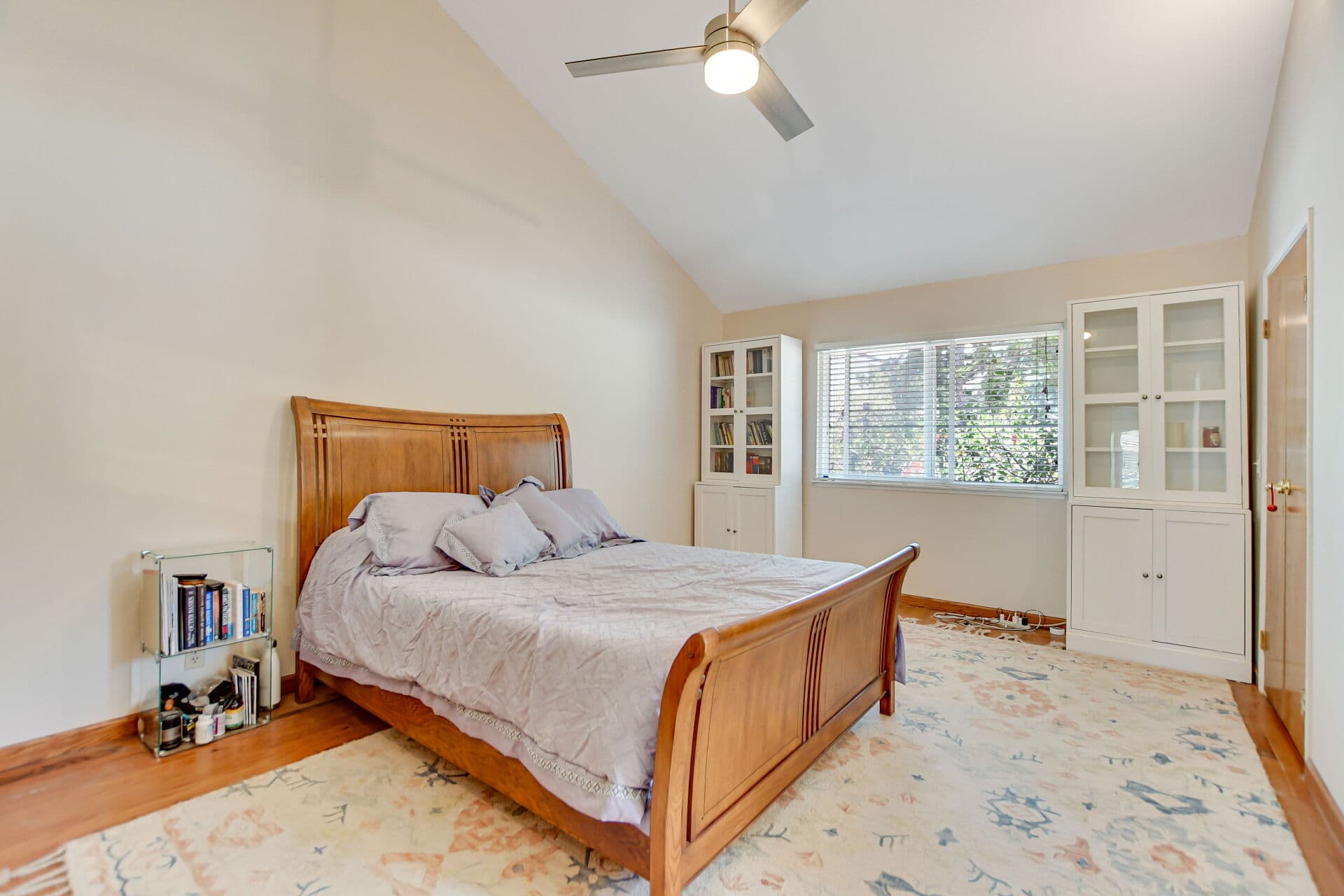
A bedroom on the street side of a house near a lively block receives headlight sweep, street lighting, and any spill from the district beyond. A bedroom on the rear elevation receives almost none of it. Two otherwise identical homes on the same block can differ enormously on this one variable, and floor plans rarely make it obvious.
When you tour a house, stand in each bedroom and work out what it faces. Then walk outside at night and look back at those windows from the street. If you can see into the room clearly, light is getting in just as easily.
The evening visit is not optional
There is no substitute for seeing a property after dark, which is the same reason the ordinary daytime tour misses so much about how a street behaves. The physical read of a block under pressure is covered in what a Claremont block looks like after dark, and the lighting question is a specific slice of that.
What to do on the visit:
- Park and sit for fifteen minutes. Count how many times a headlight beam crosses the front of the house.
- Look up. Find the nearest street light and note whether the house is inside its cone or outside it.
- Look at the neighbors' fixtures. A motion flood aimed over a fence is a real and recurring condition.
- Check the sky over the direction of the nearest gathering place. A visible glow means light is reaching this block from a distance.
- If there are trees between the source and the house, remember that trees are seasonal and mortal. Screening that depends on foliage is screening you may lose.
What you can change and what you cannot
The honest division is simple.
You can change: interior window treatment, exterior shutters or awnings, planting on your own lot, the aim and shielding of your own fixtures, and glass. Blackout treatment solves a great deal for a modest cost. Landscaping solves more but takes years.
You cannot unilaterally change: the position of a street light, the lighting on someone else's property, the orientation of the house, or where cars turn. Some of these have a process, and the process runs through the city or through the property owner in question rather than through you. Ask before you assume anything is adjustable.
Light and sound behave differently
People treat them as one problem. They are not.
Sound bends around obstacles, reflects off hard surfaces, and reaches places you would not expect, which is why the paths it takes are worth understanding on their own terms in how noise reaches your Claremont lot. Light travels in straight lines and stops at anything solid.
That difference is good news. A solid fence does very little for noise and a great deal for headlight sweep. A hedge does something for both. A wall between you and a source removes the light entirely while barely touching the sound.
So the two problems have different solutions, and a seller who says the fence fixed it may be right about one and wrong about the other.
Where this shows up in a purchase decision
Rarely as a dealbreaker. Usually as a cost, a compromise, or a reason to prefer one house over a similar one two doors down.
Price it honestly. Interior treatment for the affected rooms is a known and modest number that any installer will quote. Exterior work is larger. Reorienting where you sleep inside the house is free, and is the solution most households actually adopt.
What you should not do is assume it will not bother you because it did not bother you during a fifteen minute daytime tour. Sleep is the one thing a house has to deliver every single night, and a condition you notice at eleven at night is a condition you will notice again.
Ask the neighbors, specifically
General questions produce general answers. Ask a resident whether the street is bright and they will shrug.
Ask instead: do you use blackout curtains, and did you install them after you moved in? A household that retrofitted window treatment in the front bedrooms has answered the question completely, without having to characterize anything.
Where to take it next
For the wider set of questions about living near where a town gathers, start at the local events and civic life hub. If the property is one you are seriously considering, the paper trail on how often a block actually fills up is worth pulling, and a records search for event load before you write an offer sets out where to look.
Questions about a particular street light, fixture, or lighting standard should go to the City of Claremont, which owns the equipment and sets the rules. Anthony Grynchal has been licensed in California since November 2009.
Frequently asked questions
Can I get a street light moved or shielded?
Street lighting is public infrastructure, so any request goes through the City of Claremont rather than through a private arrangement. There is a process, outcomes vary, and it is worth asking before you buy rather than assuming a change is available.
Do trees block light from a gathering place?
Partially, and seasonally. Mature canopy screens a great deal of direct light, but foliage changes through the year and individual trees are eventually removed or pruned. Treat tree screening as a benefit you enjoy rather than a permanent feature you have bought.
Is headlight sweep worse than street lighting?
For most households, yes. Street lighting is constant and the eye adapts to it. Headlights are intermittent and moving, which is exactly the pattern that wakes people. A solid fence or wall at the right height usually addresses it.
Should light exposure change what I offer on a house?
It can, in the same way any correctable condition does. Get a quote for the window treatment or fencing that would resolve it, and weigh that against the rest of the property. It is more often a negotiating detail than a reason to walk away.

Written by
Anthony Grynchal
Anthony Grynchal is a California real estate professional with eXp Realty, licensed since November 2009 (California DRE# 01873626), and the Designated Local Expert™ for Claremont — where he has lived for more than 33 years.
More about AnthonyPublished · Updated