
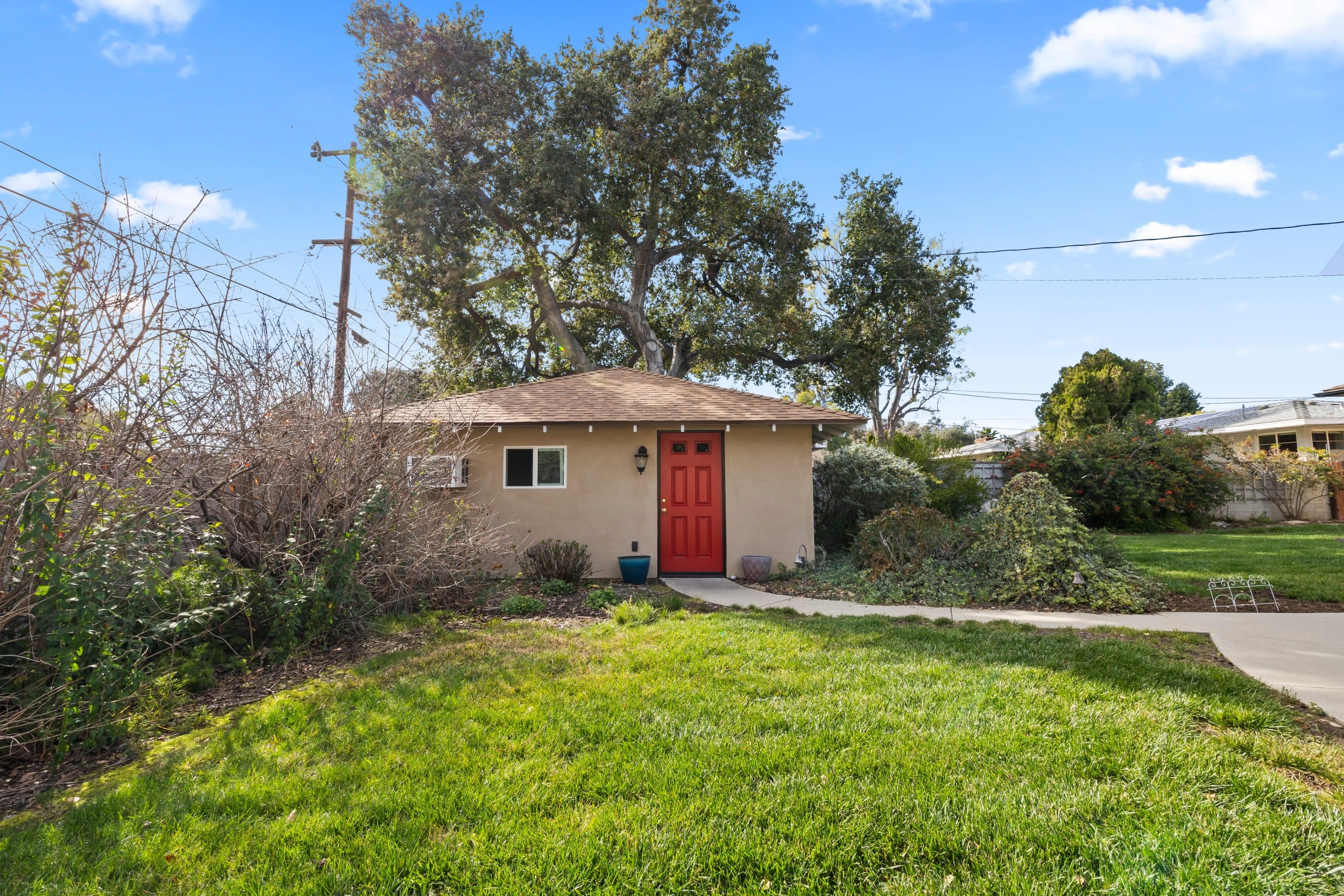
Build it with permits, or don't build it at all. That is the first rule of any ADU Claremont CA project. Permitted square footage gets credited by appraisers, lenders, and buyers. Unpermitted square footage often gets credited at close to nothing. Everything else — setbacks, cost, rent near the Colleges, your tax bill — follows from that one decision.
State law has done most of the heavy lifting here. Claremont cannot say no to a compliant unit. It cannot drag the review out. In most cases it cannot make you live on the property. What the city still controls is the detail. How close to the fence you can build, and how tall. What you pay in fees. How fast the plan check moves. Here is the whole picture, from first sketch to the day you sell.
What are the ADU Claremont CA rules?
Claremont's rules live in Chapter 16.333 of the Municipal Code, the city's Accessory Dwelling Units ordinance. The chapter's stated purpose is to increase production of ADUs and junior ADUs. It applies to lots already developed with homes. That framing matters. The ordinance is written to permit units, not to ration them.
The standards you will actually design around:
- Setbacks. An ADU must sit at least four feet from rear and side lot lines. Front setbacks follow whatever your zoning district already requires.
- Size. Claremont allows detached and attached ADUs up to 1,200 square feet. A junior ADU, which must be carved out of the existing house, tops out at 500 square feet. On a multifamily property the cap is 800 square feet. No unit may be smaller than 150 square feet.
- Height. State law sets the floor the city has to allow: 16 feet for a detached ADU. That rises to 18 feet if the lot is within half a mile of transit, or already carries a multi-story multifamily building. The state ADU Handbook from the Department of Housing and Community Development is the reference here. You and city staff will both be working from it.
- Parking. No additional parking is required within half a mile of transit. The city also cannot force you to replace parking you lose in a garage conversion.
- Owner-occupancy. Not required for a standard ADU. It is required for a JADU. It is also a condition of the city's grant program, covered below.
Process-wise, you need an Accessory Dwelling Unit Permit from the Planning Division before your plans go to Building. State law then puts the city on a clock. It has 30 days to tell you whether your application is complete. Then 60 days from a complete application to approve or deny. Miss the 60 days and the application is deemed approved. Claremont's Planning Division takes questions at (909) 399-5470. Calling before you pay an architect is free.
How does your Claremont micro-area change what actually fits?
The ADU Claremont CA rule set is identical citywide. Your lot is not. A Village-adjacent lot off Harrison or Berkeley sits within walking distance of Indian Hill Boulevard and the Packing House. Those parcels are often narrow and deep, with a detached garage at the back. They convert well, because the garage already sits past the four-foot setback line. But a 1,200-square-foot new build usually will not fit without eating the entire yard.
North Claremont is the opposite problem and the opposite opportunity. Bigger lots above Baseline. Room for a genuinely separate unit with its own approach, so a tenant never walks past your kitchen window. The city has leaned into this. Its Sixth Cycle Housing Element created an ADU-Ready RS 10,000 Overlay District for undeveloped North Claremont lots. The overlay allows subdivision under RS 10,000 standards and requires that development include an ADU. If you own raw land up there, read that chapter before you do anything else.
Foothill-adjacent parcels north of Foothill Boulevard bring slope into it. Grading is where an ADU budget quietly doubles. Claremont's grading permit alone runs a wide range depending on scope. Near the older streets around College Avenue, check whether design review or a historic designation applies to your property. Do that before you assume a modern prefab box will sail through.
Walk your lot with a tape measure first. Four feet from the fence. The required separation from the main house, the path for utilities, and where the trash cans go. Then decide where the tenant parks. Half the ADU projects that stall in Claremont stall on site constraints nobody measured.
What does an ADU Claremont CA project actually cost?
The city has published its own estimate. Per the Claremont Courier, which covered the council's April 2023 vote on the grant program, a studio starts at $100,000. A 1,000-square-foot, two-bedroom unit runs up to $300,000. Treat that as the honest range for new detached construction. A garage conversion with existing walls and a slab lands lower. A custom build on a sloped foothill lot lands higher.
The fees are smaller than people fear, but they are not zero. Per the Claremont ADU resource roundup published by Inland Abundant Housing, budget for:
- A $918 Planning Department development review fee.
- Plan check at roughly 1% of valuation, and building fees at roughly 3%.
- A $1,100 parkland fee if the unit exceeds 799 square feet.
- School district fees on anything over 500 square feet.
- A grading permit from $277 to $8,000, depending on scope.
Confirm every one of those with the city first. Fee schedules change.
One state rule is worth designing around. Under California Government Code section 66324 — renumbered to 66311.5 by SB 543 — an ADU of 750 square feet or less is exempt from impact fees. Utility connection charges must also be proportional to the unit's actual burden. The agency cannot bill the ADU as a brand-new residence. So the jump from 749 to 800 square feet costs more than the extra framing. Sometimes it is the difference between a clean permit and several thousand dollars of avoidable fees.
On timeline: figure three to four months from starting design to holding a permit. That assumes compliant plans and a complete application. Then add four to eight months of construction for a detached unit. A start-to-finish year is a realistic expectation. Anyone promising you a finished ADU in 90 days is selling something.
Can an ADU near the Claremont Colleges cover its own cost?
This is where Claremont differs from a generic Inland Empire ADU pitch. The Claremont Colleges are seven institutions on nearly 600 acres, all of it inside city limits. They enroll more than 8,000 students and employ 3,400 faculty and staff. That is a standing tenant pool of graduate students, visiting faculty, postdocs, and staff. They want to live close. They do not want a 30-unit complex in Pomona.
The rent side, per Zumper data updated August 10, 2026: studios in Claremont averaged $1,909 a month. One-bedrooms averaged $2,097 and two-bedrooms $2,495. Run the arithmetic yourself rather than taking a builder's word for it. A $2,000 one-bedroom is $24,000 gross a year. Against a $250,000 build, that is roughly a 9.6% gross return. Vacancy, insurance, maintenance, and the added property tax below all come off the top. Real net return lands meaningfully lower, and the payback period is long. It is a good asset, not a fast one.
Two practical notes for Colleges-adjacent landlords. Academic-year leases mean turnover every May and a hunting season every August. Price for a June-to-August vacancy rather than pretending it won't happen. State law also lets cities require ADU rentals of 30 days or longer. That rules out running it as a short-term rental in most cases. Check the current Claremont rule with Planning before you count on nightly income you may not be allowed to collect.
What does an ADU do to your Claremont property tax bill?
Here is the piece the builder websites skip, and it is usually better news than homeowners expect.
Adding an ADU does not trigger a reassessment of your whole property. Per the Los Angeles County Assessor, the assessor values only the new construction. That value is added to your existing assessed value. Your original Prop 13 base year on the main house stays exactly where it is. What you end up with is a blended assessment. The old, low basis on the house, plus a new, current-value line for the ADU. Both grow under the same 2% annual cap.
Now put Claremont's actual rate against it. Per Ownwell, the median effective property tax rate in Claremont is 1.29%. That is above the California median of 1.21%. The median annual bill is $6,938. So a $250,000 ADU adds somewhere in the neighborhood of $3,200 a year to your taxes at that rate. Roughly $270 a month against $2,000 of rent. That is illustrative math, not a quote. Your assessed value will be whatever the assessor concludes the new construction is worth. Your parcel's rate depends on the bonds and assessments on your tax bill.
Expect a supplemental bill after final inspection, covering the stub period. The blended total shows up on your regular secured bill after that. Budget for the supplemental. It surprises people.
Does an ADU Claremont CA build add resale value?
Yes, when it is permitted. That qualifier is doing all the work in this sentence.
A permitted, finaled ADU shows up in the appraisal as legitimate improved square footage. It carries its own contributory value. On a rental property, it can also bring income the lender will count. An unpermitted unit gets treated very differently. Appraisers work to standards that require verifying whether added space complies with code. Lending commentary out of the Los Angeles market describes unpermitted square footage being discounted by 50% to 100% of its construction cost. Then comes a further market discount for buyer hesitation. JVM Lending puts it plainly. Units built without permits are often deemed storage and given minimal value, regardless of what they cost to build.
For context on the base, Redfin's Claremont market page showed a median sale price near $1.1 million as of July 2026. That was $520 per square foot, with homes averaging 35 days on market. Do not multiply your ADU's square footage by $520 and call it appraised value. Detached accessory space rarely contributes at the same rate as primary living area. The appraiser will also hunt for comparable sales of homes with permitted ADUs nearby. That comp set is thin in Claremont, which introduces real variance.
What I see at the listing table: a permitted ADU widens the buyer pool considerably. Multigenerational families, buyers who need the rent to qualify, and remote workers who want a detached office all pay attention. An unpermitted one narrows it. Cash-heavy buyers and investors will still come. But conventional financing gets complicated. I have watched deals renegotiate hard in escrow when an appraiser flags space the city has no record of.
If you have an existing unpermitted conversion, get it legalized before you list, not during escrow. AB 2533 gives homeowners a path to permit older unpermitted units. You are not forced into full current-code compliance where the issue isn't health and safety. Start that conversation with Planning early. It takes months, not weeks.
Is Claremont's $20,000 ADU grant still on the table?
Claremont's City Council approved a local program awarding $20,000 to homeowners who build an ADU or JADU. It is structured as a forgivable loan that converts to a grant if you meet the conditions. You have to actually build the unit. You have to live in the main house. And you have to rent the ADU for three years to a moderately low-income household. First-year funding was $200,000 from the city's American Rescue Plan Act allocation. ARPA dollars are required to be spent by the end of 2026.
Two cautions. First, call Planning and confirm whether funds remain available and what the current terms are. A program funded from a closed federal bucket is not permanent. Second, read the three-year affordability covenant as a real commitment, not paperwork. If the deed restriction requires below-market rent for three years, that discount can be worth more than $20,000 in Claremont at current rents. Do the arithmetic before you sign.
At the state level, CalHFA's ADU grant remains closed to new applications. Don't build a financing plan around it.
So should you build one?
Work through these in order before you spend a dollar on design:
- Confirm the lot works. Four-foot setbacks, separation from the house, utility routing, and a usable path for a tenant. Measure before you dream.
- Set the real budget. Use $100,000 to $300,000 as the frame. Then add fees, grading, and a contingency of at least 10%.
- Decide the purpose honestly. Rental income, family housing, or resale positioning. Each one leads to a different floor plan and a different size.
- Watch the 750-square-foot line. Staying at or under it avoids impact fees entirely.
- Permit everything. Then keep the final inspection card, the plans, and the certificate of occupancy in one folder. A future appraiser will ask for it.
If your honest answer is "I want a slightly bigger house," build an addition instead. It is usually cheaper per square foot and appraises more cleanly. If your answer is income, or housing your mother nearby, or a second unit on a North Claremont lot with room for it, the math changes. An ADU is one of the few improvements in this city that pays you back in cash while you own it.
When you're ready to talk through what your specific block and lot will support, reach out to Mr. Claremont™ for a one-on-one consultation. We can walk through what it does to your position if you sell in five years.
Anthony Grynchal is a licensed California real estate agent (DRE #01873626) affiliated with eXp Realty and publishes under the Mr. Claremont Real Estate™ brand. He is the founder and CEO of MetaDLE™ Technologies, which operates the Designated Local Expert™ / UCI Coin™ products referenced in some posts. Articles are informational and are not legal, tax, or financial advice; market figures change and should be verified against current data before acting.
Frequently asked questions
How big can an ADU be in Claremont? Claremont allows detached and attached ADUs up to 1,200 square feet. Junior ADUs top out at 500 square feet, and ADUs on multifamily properties at 800. No unit may be smaller than 150 square feet. Detached units must sit at least four feet from side and rear lot lines. Confirm current standards in Chapter 16.333 or with the Planning Division at (909) 399-5470.
How long does ADU approval take in Claremont? State law gives the city 30 days to determine whether your application is complete. It then has 60 days to approve or deny a complete application, ministerially. In practice, plan on three to four months from starting design to permit issuance. Figure roughly a year from first sketch to a finished detached unit.
Will building an ADU reassess my whole property? No. The Los Angeles County Assessor values only the new construction and adds it to your existing assessed value. Your home's Prop 13 base year stays intact. At Claremont's 1.29% median effective rate per Ownwell, a $250,000 ADU adds roughly $3,200 a year. Expect a supplemental bill after final inspection.
Does an unpermitted ADU count as square footage when I sell? Generally not in the way you'd hope. Appraisers must verify code compliance. Los Angeles-market practice discounts unpermitted space by 50% to 100% of its construction cost. Lenders often exclude it from gross living area altogether. Legalize it before listing rather than during escrow.
What can I rent an ADU for near the Claremont Colleges? Per Zumper data updated August 10, 2026, Claremont studios averaged $1,909 a month. One-bedrooms averaged $2,097 and two-bedrooms $2,495. The Colleges enroll more than 8,000 students plus 3,400 faculty and staff, which supports demand nearby. Academic-year leasing does mean summer turnover you should price for.

Written by
Anthony Grynchal
Anthony Grynchal is a California real estate professional with eXp Realty, licensed since November 2009 (California DRE# 01873626), and the Designated Local Expert™ for Claremont — where he has lived for more than 33 years.
More about AnthonyPublished · Updated