
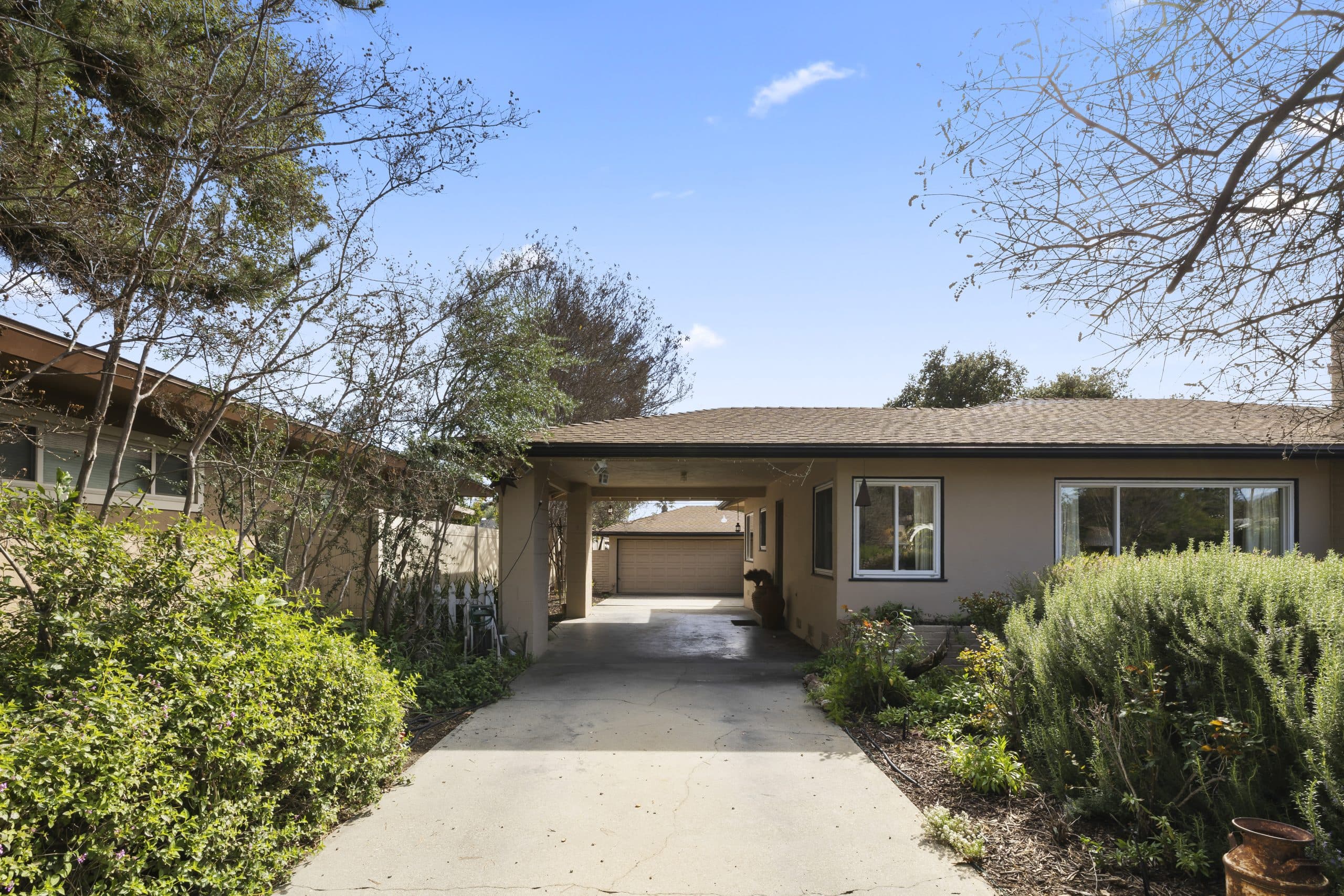
If your garage already sits on a sound slab with power running to it, convert it. If you want a unit that rents like a real apartment and reads as real square footage to a future buyer, build detached and accept the larger number. Those are the two honest answers for most owners weighing an ADU Claremont zoning will actually permit, and the gap between them is roughly $100,000 of capital and about six months of your life.
This is a comparison written from the investment side, not the builder side. No one selling you a modular unit is going to open with the sentence "your garage is probably the better deal." Sometimes it is. Sometimes it very much is not, and the deciding factor is your lot, not your budget.
What does each ADU Claremont path actually cost?
Start with construction, because that is the number everyone gets wrong first.
Per Angi's 2026 cost data, converting a garage into a livable ADU runs $150 to $400 per square foot. A typical two-car garage conversion lands between $80,000 and $150,000. Per GreatBuildz, last updated July 28, 2026, a new ADU in Los Angeles and Southern California runs roughly $300 to $450 per square foot. A 600-square-foot detached unit then sits near $180,000 to $270,000, before design and permit fees.
Two things about those bands.
First, they are hard construction only. Architectural drawings, structural engineering, plan check, a new electrical subpanel, sewer lateral work, and the trenching to reach a back-corner building all sit on top. I am not going to hand you a fake number for those, because they swing enormously with lot depth and the age of your service. On a 1920s Village bungalow near Harvard Avenue with original galvanized supply lines, the plumbing scope alone can rewrite the budget.
Second, a garage conversion is only cheap when the garage is worth keeping. An attached garage with a solid slab, a straight roof, and a panel with capacity is a bargain. A 1950s detached garage in the back corner of a North Claremont lot with a cracked slab and no trenched utilities is not. Trenching new water, sewer, and electrical lines out to a detached garage can move a conversion into detached-build territory on its own. The swing is large and entirely lot-specific, so price it before you commit. At that point you are paying detached-build prices for a building with a low ceiling and a bad footprint.
One cost item does break in the small unit's favor, and it is written into state law. Under Government Code Section 66311.5, renumbered from Section 66324 by SB 543 effective January 1, 2026, no impact fee may be imposed on an ADU with 750 square feet of interior livable space or less. That same section treats an ADU containing less than 500 square feet as construction that does not increase assessable space, which takes school district fees off the table too. That exemption is a real reason to keep a first ADU under 750 square feet unless you have a specific reason to go bigger.
- Construction cost — Garage conversion: $150–$400/sq ft; $80,000–$150,000 for a two-car garage · Detached build: roughly $300–$450/sq ft; $180,000–$270,000 for 600 sq ft
- Rear and side setback — Garage conversion: None required for an existing structure converted in place · Detached build: At least 4 feet
- Height — Garage conversion: Whatever the garage already is · Detached build: At least 16 ft; 18 ft near major transit or on a lot with multistory multifamily
- Realistic timeline — Garage conversion: Same-year finish · Detached build: Roughly a year
- Rent at platform averages — Garage conversion: About $1,788/mo as a studio · Detached build: $1,788–$2,100/mo as a one-bedroom
- Gross yield at midpoints — Garage conversion: About 18.7% · Detached build: About 9.5–11.2%
Which ADU Claremont rules differ between the two paths?
This is where ADU Claremont rules stop being a generic California checklist. Claremont's ordinance sets its own numbers inside the state framework, and the two build paths do not get treated the same.
Setbacks. Under Claremont's accessory dwelling unit chapter, an ADU must be set back at least four feet from rear and side lot lines. That four-foot figure applies to new construction. A conversion gets a better deal from the state. Under Government Code Section 66314, no setback is required for an existing accessory structure converted into an ADU. The same holds for a structure built in the same location and to the same dimensions as that existing structure. In plain terms, a garage sitting two feet off the property line can legally stay two feet off the property line as a dwelling. A new detached unit on that same footprint could not.
That single provision is the strongest argument for conversion on a narrow lot. Village-adjacent parcels south of Foothill Boulevard are often 50 to 60 feet wide. Push four feet in from both sides and a new detached build gets squeezed into a shape nobody wants to live in. The existing garage is already grandfathered where it stands.
Size. State law allows up to 850 square feet for a studio or one-bedroom and 1,000 square feet for two bedrooms or more. Claremont's posted standards cap ADUs at 1,000 square feet, set a 150-square-foot minimum, and limit an ADU to no more than two bedrooms. A junior ADU maxes out at 500 square feet. Most garages will not get you near the cap anyway. A standard two-car garage is roughly 400 square feet. That builds a very good studio and a cramped one-bedroom.
Height. Under Government Code Section 66321, a detached ADU must be allowed at least 16 feet. That rises to 18 feet within a half mile walking distance of a major transit stop or high-quality transit corridor, and to 18 feet on a lot with an existing or proposed multistory multifamily dwelling. Your own two-story house does not trigger the 18-foot allowance. Height is a detached-build question exclusively. Your garage is whatever height it already is, and the low plate line on older Claremont garages is a genuine design constraint.
Do you have to replace the parking you lose?
No. This is the single most common piece of bad information I hear from owners on this topic, and it costs people projects they should have built.
Claremont's ordinance caps required ADU parking at one space per bedroom. The space has to sit on the same lot. It is required in addition to the parking for the primary residence. Uncovered spaces may sit in required setback areas and may be tandem. That is how most owners solve it in practice: two cars nose to tail in the existing driveway.
But say you demolish or convert a garage, carport, or uncovered space for an ADU. State law bars the city from requiring those spaces be replaced. SB 1211, signed September 19, 2024 and effective January 1, 2025, extended that protection to uncovered spaces as well. Your two-car garage becomes a studio, and the city cannot make you rebuild a two-car garage somewhere else on the lot.
Layered on top is the transit exemption. State law removes the ADU parking requirement entirely for properties within a half mile walking distance of public transit. The Claremont Metrolink station sits at 200 W. First Street, in the 1927 Santa Fe depot on the San Bernardino Line. It puts a meaningful slice of the Village and the blocks around College Avenue inside that radius. Measure it before you assume. Half a mile of walking distance is not half a mile as the crow flies, and the difference decides whether you owe a space at all.
What about the ADU-Ready RS 10,000 Overlay in North Claremont?
Read the name carefully, because it does not mean what most owners assume.
The ADU-Ready RS 10,000 Overlay District implements the City's Sixth Cycle Housing Element Update and increases allowable density on the properties it covers. Every property in it carries an underlying zoning of Rural Residential RR 35,000, and lots subdivided under the chapter are then developed to RS 10,000 District standards. That is a subdivision and density tool for large North Claremont parcels. It is not a library of pre-approved ADU plans, and it is not a fast-track permit.
Own one of those big foothill-adjacent lots? Take the overlay to a land use attorney before you commit to a single detached ADU. Splitting may be the higher-value move. If you own a 7,000-square-foot lot in the Village or off Indian Hill Boulevard, the overlay has nothing to do with you. Do not let a builder wave the phrase around as if it applies citywide.
How long does each path take?
State law sets the clock. Under Government Code Section 66317, a permitting agency has 60 days to approve or deny a complete ADU application where a dwelling already sits on the lot. Miss that deadline and the application is deemed approved. SB 543, signed October 10, 2025 and effective January 1, 2026, amended that section to require a written completeness determination within 15 business days of receiving the application.
Those deadlines govern the permit, not the project. Realistic sequencing looks like this:
- Design and engineering: four to ten weeks, longer for a detached build with a full foundation and site plan.
- Plan check: the statutory 60-day window, plus however long your corrections take. The clock restarts on resubmittal, so incomplete drawings are the most expensive delay available.
- Construction: a garage conversion is usually a few months of work. A detached build carries excavation, foundation cure, framing, and separate utility trenching, and it commonly runs two to three times longer.
The honest planning number: a garage conversion is a same-year project if you start in winter. A detached build started in spring is a next-spring rental. Budget for one full lost season either way.
What can an ADU rent for near the Claremont Colleges?
Here is the demand side, and it is the reason ADU Claremont rental math works better than the same math in a comparable Inland Valley city.
Per The Claremont Colleges, as published August 2026, the consortium is seven institutions on nearly 600 acres with over 8,000 students and 3,400 faculty and staff. The faculty and staff figure matters more to you than the student one. Undergraduates are largely housed on campus. The reliable off-campus tenant pool is graduate students at Claremont Graduate University and Keck Graduate Institute. Add visiting faculty on one-year and two-year appointments, postdocs, and staff. They want to be within a walk or a short bike ride of College Avenue. Those tenants sign clean leases, leave on schedule, and are replaced every August by the next cohort.
For rent levels, use platform data and date it. Per RentCafe, whose Claremont page was last updated August 2, 2026, the average Claremont apartment rents for $2,113 at 747 square feet. Studios average $1,788 at 410 square feet. One-bedrooms average $1,788 at 652 square feet. Two-bedrooms average $2,481 at 918 square feet. Overall rent was up 1.62% year over year from $2,079. Zumper put the Claremont one-bedroom average at $2,100 as of June 2026. Treat the spread between those sources as the real uncertainty band, not as a reason to pick the higher one.
A detached, purpose-built one-bedroom with its own entrance, its own laundry, and a private patio sits at or above those averages. A converted garage with a low ceiling and a window facing the neighbor's fence sits below them. That difference is design, not luck, and it is where the extra detached money partly earns itself back.
Running the investment math on both paths
Take the midpoints and do the arithmetic in public.
Garage conversion. Call it $115,000 all-in, the middle of Angi's $80,000 to $150,000 two-car band. Rent it at the RentCafe studio average of $1,788 and you gross $21,456 a year. That is an 18.7% gross yield on cost, and a gross payback near 5.4 years.
Detached build. Call it $225,000, the middle of the $180,000 to $270,000 band for 600 square feet, and understand that figure excludes design and permit fees. Rent at the RentCafe one-bedroom average of $1,788 and you gross $21,456, a 9.5% gross yield. Rent at Zumper's $2,100 and you gross $25,200, an 11.2% gross yield. Gross payback runs 9 to 10.5 years.
Every one of those numbers is gross. Vacancy, insurance, maintenance, management if you use it, and the property tax on the newly assessed improvement all come out before you see a dollar. Assume the real net is meaningfully below the gross figure and you will not be disappointed later.
The conversion wins on yield. It is not close. What the detached build buys you is a better asset: real bedroom count, a rentable footprint that appraises more cleanly, and no shared wall with your own house. Per Redfin, the median Claremont sale price was $1,109,336 in May 2026, up 1.4% year over year. Homes sold in a median of 38 days. In a market at that price point, buyers who want a separate unit want a separate building. A converted attached garage reads to many of them as a lost garage.
Which Claremont lots suit which path?
Match the path to the parcel, not to the brochure.
- Convert when the garage is attached or close to the house, the slab is sound, and the panel has capacity. It also wins when the lot is too narrow to place a new building four feet off both lines. Common on Village-adjacent blocks and older streets south of Foothill Boulevard.
- Build detached when you have real backyard depth and a rear alley or side yard for a trenching route. It suits a buyer profile that will pay for a genuine second dwelling. Common on the larger North Claremont lots and foothill-adjacent parcels.
- Walk away, for now, if the garage needs a new slab and roof and the lot cannot take a detached unit. You are paying detached money for a compromised building. Fix the main house instead.
- Get advice first if your parcel falls inside the ADU-Ready RS 10,000 Overlay. Subdivision may beat an ADU on that land, and that decision is not reversible after you pour a foundation.
Verify your own parcel against the current ADU Claremont ordinance before you spend anything. Codes change, the state amends this chapter almost every year, and the version that governs you is the one in effect the day your application is deemed complete.
Want a second read on which path your specific lot supports, and what it would do to your resale position? Reach out to Mr. Claremont™ for a one-on-one consultation.
Anthony Grynchal is a licensed California real estate agent (DRE #01873626) affiliated with eXp Realty and publishes under the Mr. Claremont Real Estate™ brand. He is the founder and CEO of MetaDLE™ Technologies, which operates the Designated Local Expert™ / UCI Coin™ products referenced in some posts. Articles are informational and are not legal, tax, or financial advice; market figures change and should be verified against current data before acting.
Frequently asked questions
Does converting my garage in Claremont require replacement parking?
No. When a garage, carport, or uncovered space is demolished or converted in connection with an ADU, state law prohibits the city from requiring those spaces be replaced. SB 1211, effective January 1, 2025, extended that protection to uncovered spaces. Claremont can still require up to one space per bedroom for the ADU itself, on the same lot, unless you are within a half mile walking distance of transit.
How close to the property line can a detached ADU go in Claremont?
At least four feet from rear and side lot lines under Claremont's ADU chapter. A converted existing structure is treated differently. State law requires no setback for an existing accessory structure converted to an ADU. The same goes for a replacement built in the same location and to the same dimensions.
What can a converted garage realistically rent for near the 5Cs?
Use the platform averages as your ceiling and work down for design compromises. RentCafe listed the Claremont studio average at $1,788 as of August 2, 2026, and the one-bedroom average at $1,788. A 400-square-foot converted garage with a low ceiling and a poor outlook rents below that. A well-lit conversion with its own entrance and parking within a walk of College Avenue can reach it.
How big can an ADU be in Claremont?
State law allows 850 square feet for a studio or one-bedroom and 1,000 square feet for two or more bedrooms. Claremont's standards cap ADUs at 1,000 square feet with a 150-square-foot minimum and no more than two bedrooms; a junior ADU is limited to 500 square feet. Government Code Section 66311.5 bars impact fees entirely on an ADU with 750 square feet of interior livable space or less.
How long does ADU approval take in Claremont?
The city must approve or deny a complete application within 60 days, and the application is deemed approved if it does not, under Government Code Section 66317. Completeness review is due within 15 business days. Design and construction sit outside that clock: plan on a same-year finish for a garage conversion and roughly a year for a detached build.

Written by
Anthony Grynchal
Anthony Grynchal is a California real estate professional with eXp Realty, licensed since November 2009 (California DRE# 01873626), and the Designated Local Expert™ for Claremont — where he has lived for more than 33 years.
More about AnthonyPublished · Updated