On a large Claremont parcel the landscape is not decoration around the house. It is a substantial part of what the property is, what it is worth, and what it will cost to keep.
Buyers walking an estate tend to register the planting emotionally and then price only the building. Sellers tend to assume mature trees are pure credit. The truth is in between, and it is more specific than either instinct.
Why maturity is the value
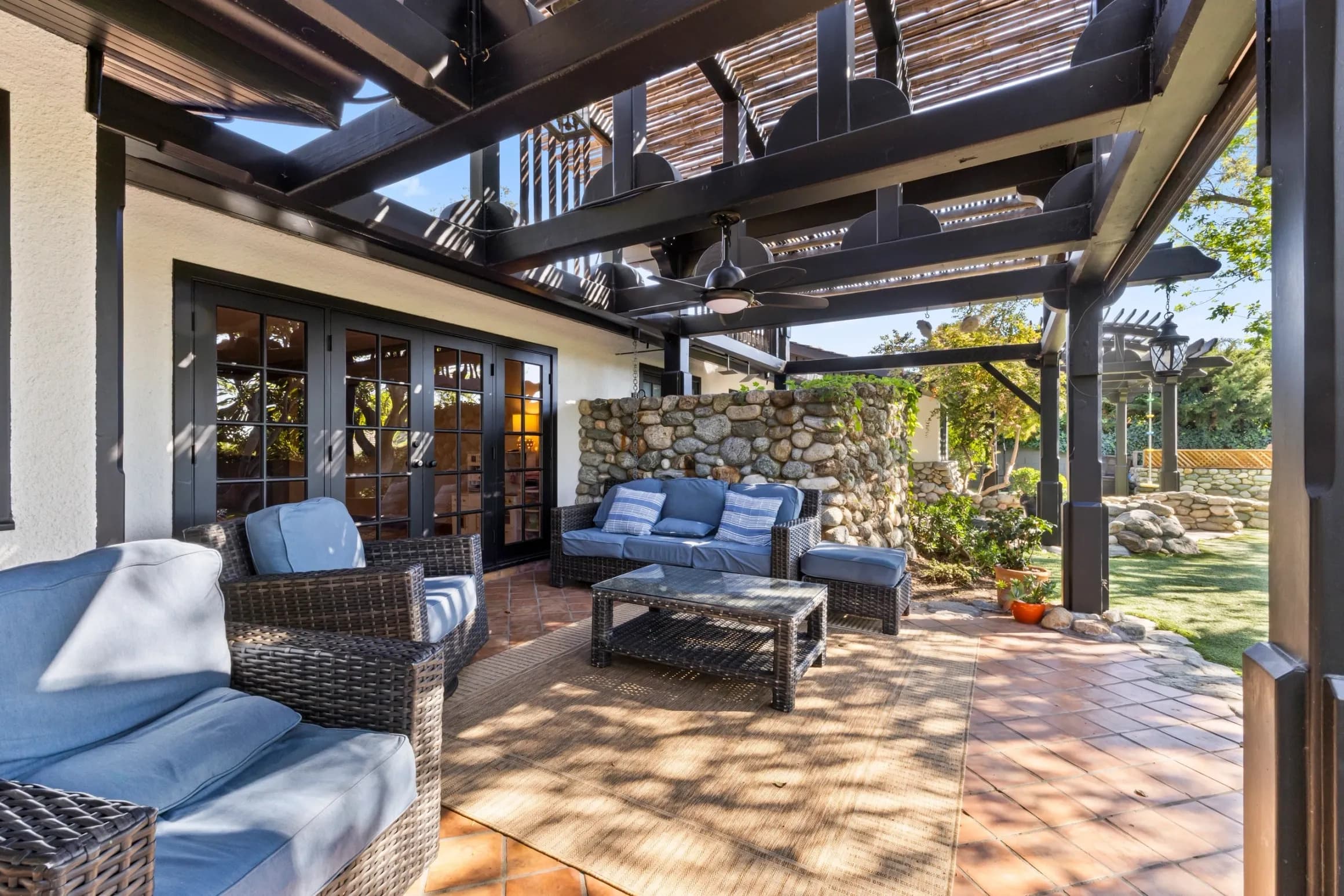
Established landscape cannot be bought. A specimen oak, a grove of olives, a hedge that has taken a generation to close, a canopy that shades a west-facing terrace in late summer — none of it can be installed and none of it can be accelerated.
That is the whole argument. Where the landscape is genuinely mature, it does what new planting cannot: it screens, it cools, it settles the house into its site, and it makes the property feel older and more established than any construction detail could.
The corollary is that new landscaping installed shortly before a sale rarely returns what it cost. It reads as new, it has not filled in, and a buyer sees an irrigation system and a warranty period rather than a mature garden.
Oaks, and why they are their own category
Claremont's coast live oaks are the most valuable and the most constrained thing on many foothill parcels.
Value: a mature oak in good structural condition is a defining feature of a property, and it is one of the reasons a hillside lot reads the way it does.
Constraint: significant trees may be regulated, which means a mature oak in the wrong place is not simply removable, and work near one can require review. Any buyer whose plan depends on removing, heavily pruning or building near a large tree should confirm what is actually permitted with the city before the contingency period closes, not after.
Care: oaks have specific needs that conflict with conventional garden practice, particularly around summer irrigation near the trunk and the root zone. A great deal of oak decline in this town traces back to a lawn or a planting bed installed under the canopy with good intentions.
Condition: a large tree near a structure needs an arborist's assessment of health, structural condition and root activity, which belongs in the estate diligence set described in inspecting a Claremont estate.
Olives, citrus and the agricultural inheritance
Olives and citrus appear on Claremont properties for historical reasons, and mature specimens of both are genuinely appealing.
They also carry maintenance nobody mentions on the tour. Olives drop fruit, and fruit on hardscape stains and creates a slip surface, so a mature olive over a terrace or a drive is an annual job. Fruiting citrus needs pruning, feeding and pest attention to stay presentable, and a neglected grove reads as neglect across the whole property.
Both are worth having. Both should be priced with their upkeep in view rather than treated as free character.
Water, and what it costs to keep this alive
Southern California water reality applies to estates the same as anywhere, and it applies to more square footage.
Ask for the actual usage history on a property with extensive planting. Ask what is on irrigation, how it is zoned, how old the controllers and valves are, and whether any part of the system runs from a source other than the municipal supply — because that carries its own rights and its own diligence.
Then ask the harder question: is the planting appropriate to the site, or is it being kept alive by volume? A landscape built on drought-appropriate and native material with mature structure is an asset. A landscape that needs constant water to look acceptable is a recurring cost and a vulnerability in any dry stretch.
There is a middle path most estate owners in this town end up on: keep the mature trees and the structural planting, and replace the water-hungry filler over time. The general approach to lower-water planting is well covered elsewhere; what is specific here is that on a large parcel the decision is financially material rather than a preference.
Where landscape becomes a liability
Four things worth checking, none of them visible from the driveway.
ROOTS AND STRUCTURES. Large trees near foundations, hardscape, walls and sewer lines. Root intrusion into an older sewer lateral is common in this town and a camera inspection settles it.
SLOPE PLANTING. On hillside parcels, planting is doing structural work in holding soil. Bare or dying slope planting is a drainage and erosion problem before it is an aesthetic one.
DEFENSIBLE SPACE. Properties at the foothill edge sit in a fire environment, and vegetation management around structures is both a safety matter and an insurance matter. Carriers look closely at clearance, overhanging limbs and the condition of the ground near the house.
OVERHANG AND ROOFS. Canopy over a roof drops material into gutters and valleys and keeps the surface damp. On a large roof that is a real maintenance load.
What sellers should actually do
Do not plant. Restore.
Clean the hard edges: drive, paths, walls, gravel, edges of beds. Have the mature trees properly pruned by an arborist rather than sheared by a crew, because bad pruning on a specimen tree is visible to anyone who knows trees and it is not reversible. Get irrigation working correctly and prove it. Clear the dead material out of beds and off slopes. Tidy the equipment and utility areas.
Then DOCUMENT it. An arborist report on the significant trees, a note of what has been maintained and when, and a plan of what is irrigated and how. A buyer who is handed a maintained landscape with records treats it as an asset. A buyer who is handed a beautiful but unexplained one treats it as an unknown liability and prices it accordingly.
The preparation sequence for the property as a whole is in luxury home staging in Claremont, and the wider top-tier process is mapped on the Claremont luxury homes hub. Anthony Grynchal has been licensed in California since November 2009.
Frequently asked questions
Does mature landscaping add value to a Claremont estate?
Yes, because it cannot be bought or accelerated. A specimen tree, an established grove or a closed hedge screens, cools and settles a house into its site in a way new planting cannot. New landscaping installed just before a sale rarely returns its cost.
Can I remove a large oak on my Claremont property?
Not necessarily. Significant trees may be regulated, and work near one can require review. Any plan that depends on removing, heavily pruning or building near a large tree should be confirmed with the city before the contingency period closes.
What landscape problems should a buyer inspect for?
Roots near foundations, hardscape and sewer lines, which a camera inspection can settle; slope planting that is holding soil; defensible space and clearance around structures, which carriers examine; and canopy over roofs, which adds real maintenance load on a large house.
Should a seller install new planting before listing?
Usually not. Restore instead: clean hard edges, have specimen trees properly pruned by an arborist rather than sheared, get irrigation working, clear dead material, and document what has been maintained. Cleanup and repair outperform new installation almost every time.

Written by
Anthony Grynchal
Anthony Grynchal is a California real estate professional with eXp Realty, licensed since November 2009 (California DRE# 01873626), and the Designated Local Expert™ for Claremont — where he has lived for more than 33 years.
More about AnthonyPublished · Updated