
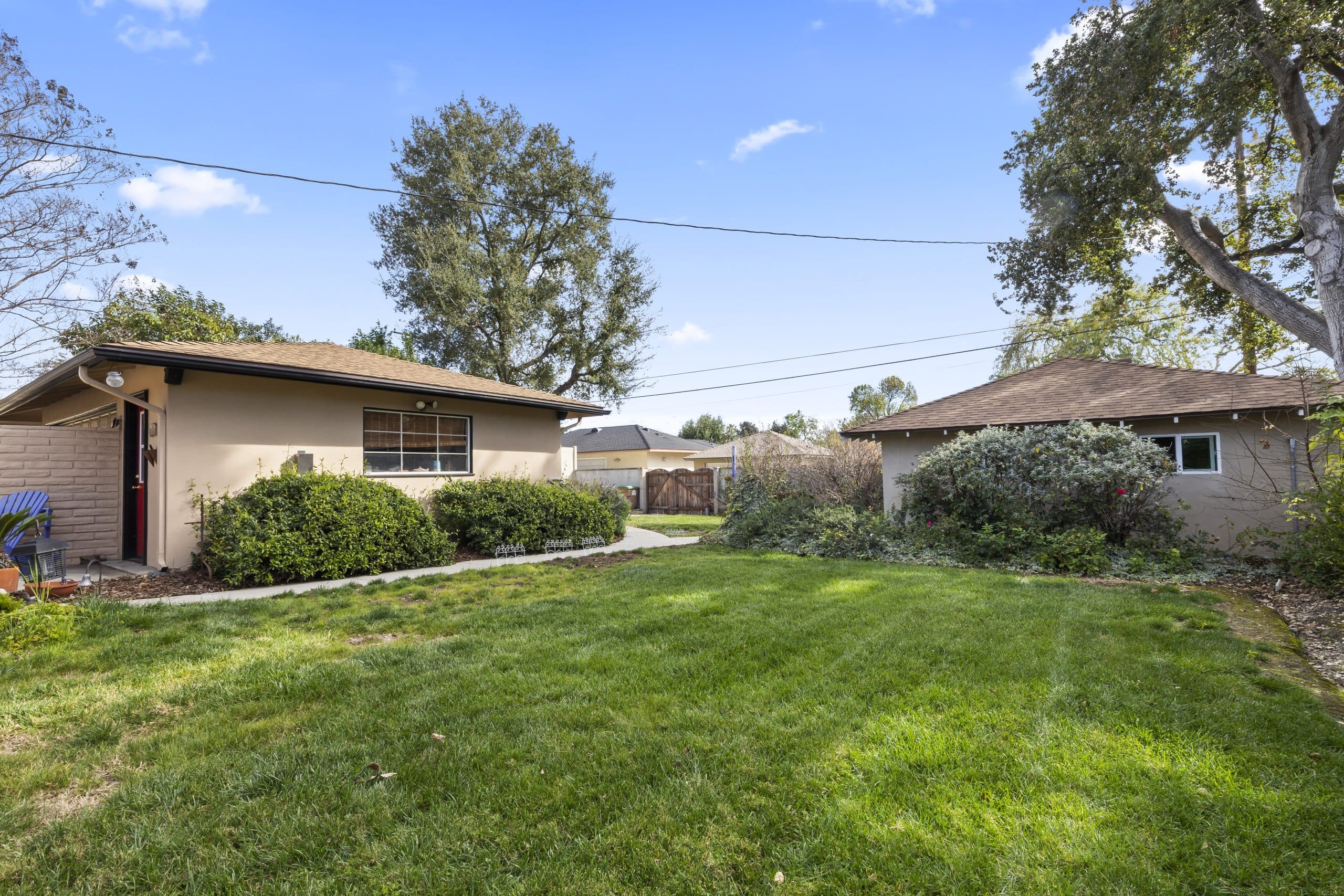
If your garage became a bedroom before 2020, you can probably legalize it. California made that path easier than it was two years ago. Most ADU Claremont searches come from people planning a new build. This page is for the other group. You already have the space, and it never got a permit. You need to know whether the city will sign off, what it costs, and what happens if you list the house without dealing with it.
Claremont has a lot of this. Per NeighborhoodScout's Claremont housing profile, roughly half the city's homes date to the 1940s through the 1960s. Another 8% were built before 1939. That is sixty to eighty years of enclosed patios and bumped-out bedrooms. Converted garages behind Craftsman bungalows near the Village. Back-lot casitas on the deeper foothill lots above Baseline Road. Some of it was permitted. A lot of it was not.
Name what you actually have before you call anyone
The single most expensive mistake is assuming every unpermitted room is the same problem. It isn't. The state's amnesty law covers only one category.
- An unpermitted ADU. Independent living: a kitchen, a bathroom, a place to sleep, its own entrance. A converted detached garage off the alley, or a back-yard casita someone finished out in 2014.
- An unpermitted JADU. Up to 500 square feet carved out of the existing house, with an efficiency kitchen. It can share a bathroom with the main home.
- An addition that is not a dwelling. An enclosed patio, a bedroom bump-out, a family room extension, a converted garage used as an office with no kitchen and no separate entry. This is not an ADU, and the amnesty law does not touch it.
- A casita with no kitchen. Detached, finished, sometimes plumbed for a bathroom, but not independent living. The city treats this as an accessory structure, not a dwelling — different height limits, different setbacks, different permit.
Write down which one you have. Everything downstream — the law that applies, the code you get inspected against, the fees — follows from that answer.
AB 2533 changed the math for any ADU Claremont owners built before 2020
AB 2533 took effect January 1, 2025. It amended Government Code Section 66332, and it is the closest thing California has to an amnesty for unpermitted second units.
The core rule is short. A local agency cannot deny a permit for an unpermitted ADU or JADU built before January 1, 2020, simply because it violates building standards or local ADU rules. The one exception is a finding that correcting the violation is necessary to protect health and safety. The earlier rule, from SB 897 in 2022, reached only units built before January 1, 2018. AB 2533 pulled the cutoff forward two years. That sweeps in a large share of the conversion work people did around here.
Three things follow from that, and they matter more than the headline:
You are not inspected against today's new-construction code. The measuring stick is Health and Safety Code Section 17920.3. That statute defines when a building is "substandard." Egress, ventilation, dampness and visible mold, faulty wiring, inadequate sanitation. Not ceiling height by a quarter inch. Not the setback your neighbor's fence sits on.
No impact fees. A homeowner permitting a pre-2020 ADU or JADU under this section cannot be charged impact fees, connection charges, or capacity charges. The exception is narrow. It covers utility infrastructure genuinely required to meet those health and safety standards.
No penalty for coming forward. The inspector's job under the statute is to identify what fails health and safety and recommend fixes. The agency then has to approve the permits needed to correct it. A separate provision lets an owner apply to delay enforcement of building standards for up to five years. That applies where correcting the violation is not necessary to protect health and safety.
That is a real change. Before 2025, plenty of Claremont owners kept quiet about a converted garage. They assumed the city's answer would be "tear it out."
Where the amnesty stops helping, and most owners find out late
AB 2533 is narrower than the marketing around it suggests. Four common situations fall outside it.
The work is not an ADU. An enclosed patio off a mid-century ranch north of Foothill Boulevard is an addition. So is a permitted bathroom that quietly grew into a master suite. Additions take the ordinary as-built permit path. They get measured against current code. No fee waiver, no protective finding.
The work was built after January 1, 2020. The statute's date is hard. A casita finished in 2021 is a standard ADU application under Claremont's current rules and state ADU law. That means setbacks, height, and separation requirements you may not meet as built.
There is a genuine safety hazard. Sleeping rooms without proper egress windows. A subpanel someone wired themselves. A gas line run without inspection. A slab addition with no footing under a bearing wall. The city can require correction. Sometimes correction means opening walls or removing part of the structure.
Nobody can tell what's under the finishes. This is the practical killer. Drywall went up over framing, plumbing, and wiring no inspector ever saw. Expect to open sections of wall, ceiling, or slab so a plans examiner can verify what's there. On a 1950s garage conversion with no vapor barrier under the slab, that discovery step is where budgets move.
The ADU Claremont permit path runs through 207 Harvard Avenue
Claremont runs its own Building Division out of City Hall at 207 Harvard Avenue. Planning and Building are the two counters you'll deal with. The city's Accessory Dwelling Units page carries the current forms and submittal requirements, as does its building permits and plan checks page. An ADU Claremont never inspected has to be documented from scratch. Community Development answers at (909) 399-5470. The permit inspection status line is (909) 399-5477. Call before you draw anything.
The sequence for an as-built permit generally runs like this:
- Pull the property's permit history first. Ask the Building Division for the address's permit records. Sometimes the work was permitted and simply never finaled — a much smaller problem, and a different conversation.
- Get a set of as-built plans. A designer or architect measures what exists and draws it as it stands: floor plan, elevations, electrical, plumbing, structural.
- Bring in a licensed structural engineer where framing or foundation is in question. Anything holding up a roof that no one inspected needs a stamp.
- Submit for plan check, expect corrections. Then a site inspection, then the destructive-verification list, then the corrections themselves, then a final.
On timing, be realistic. State ADU law caps ministerial review of a complete, compliant application at 60 days. The HCD ADU Handbook is the reference for the baseline rules. Cities must allow ADUs of at least 800 square feet and JADUs up to 500. Four-foot side and rear setbacks. No replacement parking when you convert a garage. No fire sprinklers if the main house doesn't have them. That clock covers the city's review, not your corrections. Real legalizations commonly run several months from first drawing to final sign-off. Confirm Claremont's own size and height caps with Planning, since local limits sit on top of the state floor.
The cost range, and what the range leaves out
Most articles lose the plot here with a single national number. Split it into three buckets.
Documentation. As-built drawings, a structural engineer, plan check and permit fees. Per ADU Zoning's 2026 Los Angeles garage conversion guide, permit fees for an ADU project run $4,000 to $15,000, depending on size and type. Drawings and an engineer's stamp sit on top of that. Both scale with how little documentation already exists. Those are Los Angeles-area contractor figures, not Claremont bids. Treat them as directional and get two local quotes.
Corrections. Unknowable until the walls are open. Egress windows, a properly sized panel, insulation, drainage, a footing under a wall that never had one.
Full conversion cost, if the space is rough. The same 2026 guide puts a complete garage-to-ADU conversion at $80,000 to $180,000. A new detached ADU runs $150,000 to $350,000. Again, regional and directional. A conversion done well in 2016 may need nothing but paperwork.
Stop worrying about one cost: property taxes on the whole house. Per the Los Angeles County Assessor, adding an ADU does not trigger reassessment of the entire property. The existing home keeps its Proposition 13 base year value. Only the new construction gets its own value added, usually as a supplemental bill after final inspection.
What unpermitted square footage does to your Claremont sale
This is the part competitors skip. It is also the part that costs money.
Disclosure is not optional. Under California Civil Code Section 1102, a seller of a one-to-four unit residential property must disclose known unpermitted additions or alterations on the Transfer Disclosure Statement. Selling "as-is" does not erase that duty. Neither does the fact that a prior owner did the work. Checking "no" on a box you know the answer to is how sellers get sued two years after closing. AB 968 adds a layer for quick resales. A seller who took title within the previous 18 months must disclose room additions, structural modifications, and contractor repairs costing $500 or more.
The appraiser will not simply count the space. Fannie Mae's Selling Guide requires the appraiser to comment on unpermitted work and support its market impact. Where a unit doesn't conform to zoning, the report has to show the use is typical for the market. That usually means at least two comparable sales with the same non-compliant zoning use. In practice, your 400-square-foot converted garage may be valued as an amenity rather than as living area. The price-per-square-foot math your neighbor got does not apply to you.
The lender is the real gatekeeper. Buyers in Claremont at this price point are financing. Per Redfin's Claremont housing market page, the median sale price was about $1.1 million in July 2026, up 1.4% year over year. Homes sold after an average 35 days on market. At that number, most buyers need an appraisal to support the contract price. They also need an underwriter to accept the property. An unpermitted unit the appraiser flags can shrink the loan, trigger a repair condition, or kill the file. Usually at day 17, after inspections, when your leverage is gone.
Cash and contractor buyers price the risk in, hard. They discount for uncertainty. That discount is almost always larger than the actual cost of legalizing. The gap is the argument for handling it first.
A decision framework for sellers, and for buyers walking into it
There are only three honest choices.
- Legalize before listing. Best when the unit qualifies for the pre-2020 amnesty and the construction looks competent. You also need four to eight months before you have to be on the market. You convert an underwriting problem into finished square footage with a permit final behind it.
- Disclose fully and sell as-is. Best when the work is post-2020, a safety correction would mean demolition, or you need to move now. Price it honestly and disclose in writing. Hand over your permit-history research. Expect a buyer pool tilted toward cash. Never list unpermitted space in the square footage a buyer pays per foot for.
- Do neither and hope. Not a strategy. It ends in a renegotiation, a canceled escrow, or a lawsuit.
Buying a Claremont home with unpermitted space? Your homework is short and non-negotiable. Pull the permit history at the Building Division yourself. Confirm the construction date, since it decides whether AB 2533 applies. Have your inspector look at egress, wiring, and any wall doing structural work. Get a contractor's number on corrections during your contingency period, not after. If the seller quotes rental income from a unit that can't legally be rented, treat that number as zero. Sometimes the right move on a foothill property with a homemade back-house is to walk. That is a fine outcome. There is another house.
Whichever way you're pointed, the sequence is the same. Identify the structure type, pin the construction date, pull the records, then decide. Everything else is guessing.
If you're weighing whether to legalize before listing or disclose and sell as-is, reach out to Mr. Claremont™ for a one-on-one consultation. It's a straightforward conversation, and it's cheaper to have before the sign goes in the yard.
Anthony Grynchal is a licensed California real estate agent (DRE #01873626) affiliated with eXp Realty and publishes under the Mr. Claremont Real Estate™ brand. He is the founder and CEO of MetaDLE™ Technologies, which operates the Designated Local Expert™ / UCI Coin™ products referenced in some posts. Articles are informational and are not legal, tax, or financial advice; market figures change and should be verified against current data before acting.
Frequently asked questions
How do I find out whether a room in my house was ever permitted?
Start with the City of Claremont Building Division at 207 Harvard Avenue. Request the permit history for your address; Community Development is at (909) 399-5470. Compare what's on file against what's standing. Also check the Los Angeles County Assessor's recorded square footage. A room that exists in real life but not in either record is your answer.
Can I keep renting the converted garage while I go through legalization?
Talk to a real estate attorney before you collect another month. Renting an unpermitted dwelling exposes you to code enforcement and tenant claims. The income is generally not usable by a lender or an appraiser until the unit is legal. Existing tenants also have relocation and notice rights. Those don't disappear because the unit lacks a permit.
Will my homeowners insurance cover a structure the city never inspected?
Ask your carrier directly and in writing. Insurers can limit or deny claims involving structures and systems they weren't told about. Unpermitted electrical work is a common friction point. Fannie Mae's guidance also conditions eligibility partly on the lender confirming a non-conforming unit won't jeopardize insurance claims. That tells you how seriously underwriters take it.
Does legalizing an ADU change what I can charge in rent?
It changes who will pay it. A permitted, finaled unit can be advertised as a legal second dwelling, documented for a lender, and counted by an appraiser reviewing income. An unpermitted one trades in a smaller, more cautious pool of tenants. Rent levels near the Claremont Colleges and the Village behave differently than in North Claremont. Price against actual current listings rather than a rule of thumb.
Is a detached casita treated the same as a garage conversion?
No, and this trips people up constantly. If the casita has a kitchen and independent living facilities, it's an ADU Claremont reviews under state law. Without a kitchen, the city generally treats it as an accessory structure, with its own height, setback, and use limits. It cannot legally be occupied as a separate dwelling. Confirm the classification with Claremont Planning before you spend money on drawings.

Written by
Anthony Grynchal
Anthony Grynchal is a California real estate professional with eXp Realty, licensed since November 2009 (California DRE# 01873626), and the Designated Local Expert™ for Claremont — where he has lived for more than 33 years.
More about AnthonyPublished · Updated