Ask a Claremont homeowner where the dividing lines in town are and you will get a confident answer that varies by who you asked. North and south are the halves everyone recognizes, and the value difference between them is real. What is usually missing is the explanation, and the explanation matters more than the label, because the underlying causes are what a valuation actually works with.
Nothing here is a ranking. Neither half is better. They are different products built in different decades for different lives, and each is worth exactly what the buyers who want that product will pay.
The halves were built at different times
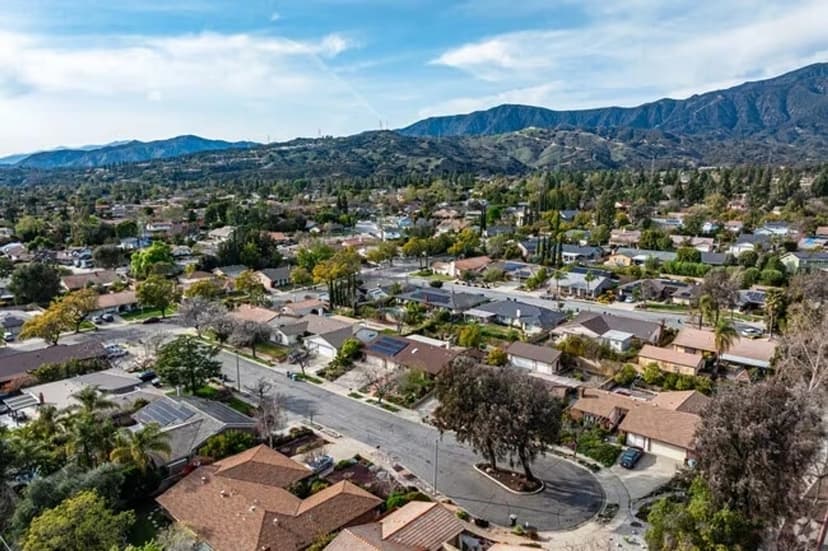
The single biggest driver is chronology. Claremont grew outward from its center over many decades, and the housing stock records that sequence. The older core carries earlier architecture on a compact street grid laid out when walking was the default. Development moved north over time toward the foothills, into larger tracts on larger parcels, planned around cars and yards.
That means almost everything people notice about the difference is downstream of when a neighborhood was built: lot dimensions, setbacks, garage placement, ceiling heights, floor-plan logic, street width, and whether the block was designed to be walked or driven. Those are the real variables. North and south are shorthand for a cluster of them.
What the northern side tends to sell on
The northern tracts and hillside streets generally compete on space and setting. Parcels are larger, yards are more usable for the things families want space for, and the foothills are close enough to be part of daily life rather than a view from a freeway. Toward the upper streets, elevation introduces outlook as its own axis, and on those blocks view quality varies lot by lot rather than tract by tract.
The buyer who pays most enthusiastically here is usually buying room and quiet. Their comparison set often includes neighboring foothill communities rather than other Claremont submarkets, which is a useful thing to know when marketing a northern home, because the competition is not only local.
What the southern side tends to sell on
South of the Village, the story is access and entry. Streets sit closer to the regional connections, and a wider range of housing types and price points exists, which makes this where a lot of people begin in Claremont. Buyers here are frequently trading a larger lot for a shorter commute, a lower entry point, or both, while still choosing the same city, the same district, and the same canopy program.
That last point is worth stating plainly, because it is often assumed away: the amenities that define Claremont's identity, the Village, the Colleges, the trees, the school district, belong to the whole city, not to one half of it. What varies is the housing product and the distance to each amenity, not membership.
Canopy age is a quiet third variable
Because the halves were planted at different times, their street trees are at different stages of maturity, and canopy is one of the features Claremont buyers respond to most immediately. Older neighborhoods often carry fuller, more established streetscapes; newer tracts may have plantings that are handsome but not yet dominant.
This cuts across the simple north and south story, which is why it is worth separating out. There are mature, deeply canopied streets in newer areas and thin streetscapes in older ones, and the block always outranks the region. How canopy shows up in value covers the mechanism.
Why the halves are not comparable to each other
The practical valuation consequence is the one homeowners most often get wrong. A sale in the other half is rarely a comparable for your home, no matter how similar the house looks in a listing summary. Different era, different lot logic, different buyer, different competitive set. Using it as evidence produces a number with a confident decimal point and nothing behind it.
This is also the specific failure that makes automated estimates unreliable in Claremont. A model drawing on a radius around an address reaches across these boundaries constantly, because the city is small enough that the circle does not respect them. Reading comps properly is largely the discipline of refusing sales that fail the same-product test.
Questions worth asking about your own address
- What era is my house, really? Not what the neighborhood is known for. The individual house and its original floor plan set the product type.
- What is my lot doing for me? Usable outdoor space, orientation, and privacy matter more than raw parcel size on most streets.
- What does my street feel like on arrival? Traffic, canopy, and the condition of neighboring frontages are part of what a buyer prices.
- Who is my actual buyer? Space seeker, walkability seeker, first entry into Claremont, or someone trading down. That answer shapes both pricing and presentation.
- What is genuinely competing with me this month? The competition is homes a buyer would consider instead of yours, which is not the same as homes near yours.
Getting from the pattern to a number
Everything above is structure. Structure narrows the question and rules out bad evidence, but it does not produce a value, and no honest article can. Your number comes from recent, genuinely comparable sales in your own submarket, adjusted for the differences that matter, read against what is currently available to buyers.
If you want that done for your address, whichever half you are in, start at the Claremont home values hub and then read how a valuation is built step by step so you know what the process involves. Call (909) 731-5374 to get yours started. Anthony Grynchal has been licensed in California since November 2009.
Frequently asked questions
Is north Claremont worth more than south Claremont?
They are different products rather than better and worse. Northern tracts generally trade on larger lots, proximity to the foothills, and on the upper streets outlook; southern neighborhoods trade on access and a wider range of entry points. Value depends on the individual property, street, and condition, not on the half of town.
Can a sale in the other half of town be used as a comp?
Rarely. The halves were built in different eras with different lot logic and attract different buyers, so a house that looks similar in a listing summary is often not the same product. Using a cross-town sale as evidence is a common route to a confident but unsupported number.
Do both halves share the same schools and amenities?
The Village, the Colleges, the street tree program, and the school district belong to the city as a whole. What changes between neighborhoods is distance to each and the type of housing, not access. Attendance boundaries within the district should always be verified directly with Claremont Unified for a specific address.
Why do online estimates struggle with this?
Automated models typically pull comparable sales from a radius around an address, and Claremont is small enough that such a circle crosses submarkets built decades apart. The model treats those sales as interchangeable when a local analysis would not.

Written by
Anthony Grynchal
Anthony Grynchal is a California real estate professional with eXp Realty, licensed since November 2009 (California DRE# 01873626), and the Designated Local Expert™ for Claremont — where he has lived for more than 33 years.
More about AnthonyPublished · Updated