
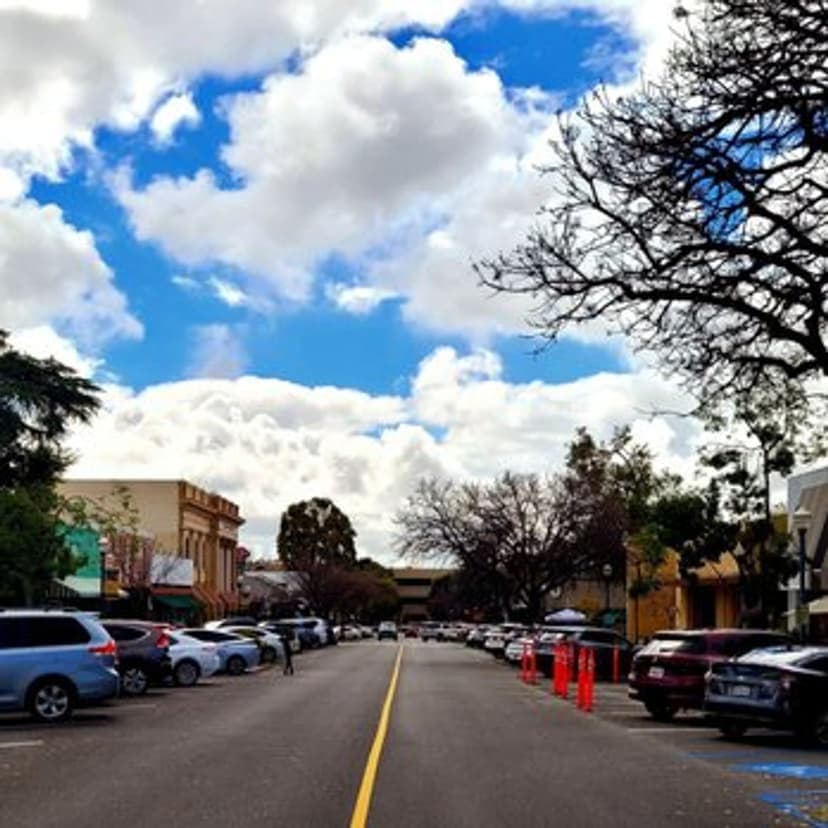
A Claremont household can go days without starting the car, and another Claremont household a short drive away cannot. The difference is not willpower — it is address, and it is one of the most underrated variables in a local home search. Walkability here is real, but it is LOCAL: a compact core, an inherited street grid, a deep shade canopy, and a cluster of institutions produce genuine car-light daily life inside a certain radius and something much more ordinary outside it. This guide covers what makes the walking work, which errands actually go on foot, and how to audit a candidate address before you commit to it. It deepens the lifestyle guide; the machinery behind the town's face-to-face habits belongs to the town-character guide, and whether that life suits you is the fit guide's question.
What makes the walking work
Four things, and they compound. THE GRID: the older parts of town were platted in walkable blocks with sidewalks on both sides and frequent crossings, which means a pedestrian gets somewhere in a straight line rather than looping out to a collector road. THE CORE: the Claremont Village concentrates most of what a person needs into a few blocks rather than dispersing it along a highway strip — the single biggest structural difference between this town and much of what surrounds it. THE CANOPY: shade is pedestrian infrastructure in an inland valley, and Claremont's street trees are the reason a summer errand is merely warm rather than impossible; the town's tree protections, read correctly, are a walkability policy. And THE INSTITUTIONS: the colleges' campuses are porous, walkable ground, the depot puts regional rail at the Village's edge, and the civic buildings sit where people already are. Add the Thompson Creek Trail on the north side and a resident has a car-free spine as well as a car-free core. Two smaller factors matter more than they look: BLOCK LENGTH, because short blocks give a walker frequent chances to turn while giving a driver fewer chances to build speed, and STREET WIDTH, since a narrow residential street is crossed casually where a wide one has to be negotiated. None of this is accidental. It is a plat, a set of ordinances, and a century of institutional decisions doing what marketing cannot — the same deliberateness the town-character guide documents, expressed as sidewalks.
The errands that actually go on foot
Inside the walkable radius, a realistic list looks like this: the morning coffee, the small grocery run, the post office, the library, the bank, a haircut, dinner out, a drink after, and the entire category of browsing that people do when a downtown is pleasant rather than merely functional. Add the school walk for families placed right, the campus lecture or concert that costs nothing but a stroll, and the errand that is not an errand at all — the evening loop that exists because the sidewalks are shaded and the neighbors are out. TIME OF DAY does more work here than distance does. An inland afternoon in the dry months turns a pleasant walk into a chore, so walking life in Claremont concentrates into mornings and evenings and expands again as the weather cools — which is why residents will tell you the town is more walkable in November than in July while nothing about the geography has moved. What this guide will NOT do is list the businesses, because a specific shop's hours, ownership, and existence all change faster than an article can track; the current answer to what is open and when belongs to the city's own listings and to the merchants' own pages, and the local business cluster treats the ecosystem rather than the directory. The durable point is structural: the MIX is dense enough and the DISTANCES short enough that a household inside the radius genuinely reorganizes its week around walking. Outside the radius, the same errands are a brief drive — pleasant, easy, and completely different in daily texture.
Buying for it: the walk audit
Walkability is sold in listings as an adjective. Treat it as a measurement instead, and take it yourself. WALK THE ERRAND, not the block: from the actual front door to the actual destination, at the hour you would really go. DO IT IN SUMMER HEAT and DO IT AFTER DARK, because an inland afternoon and an unlit stretch are the two conditions that quietly convert a walker back into a driver. COUNT THE BARRIERS: a major arterial without a signal, a missing sidewalk segment, a long block with no shade — any one of them can sever an otherwise short route. CARRY SOMETHING, because the grocery test with full bags is the honest version. CHECK THE CANOPY along the route, not just on the lot. TEST IT THE WAY YOUR HOUSEHOLD ACTUALLY MOVES, because a stroller, a scooter, a wheelchair, or an older parent's pace will find the curb ramps, driveway aprons, and root-lifted pavement that a fit adult on a dry evening walks straight over. And READ THE PRICE GRADIENT for what it is: proximity to the core is capitalized into land here, so the walkable address costs more, and the real question is whether your household will spend that difference in daily use or simply admire it. Be honest about the limits, too. Regional work, the freeway commute, and most of what a household needs from a metropolitan area still assume a vehicle. Claremont offers car-LIGHT living rather than car-free living, and the households happiest here bought that distinction deliberately. The neighborhood guides are where the geography gets specific, address by address.
Anthony Grynchal has been licensed in California since November 2009, and the walk audit is the showing request he honors most gladly — it is the one test that tells a buyer something a listing cannot. This is general information; current hours, routes, and city programs belong to their own publishers.
Frequently asked questions
Is Claremont actually walkable?
Parts of it genuinely are. The Village core, the older grid neighborhoods around it, and the porous campus edges support real car-light daily life — shaded sidewalks, short blocks, and a downtown dense enough to hold most errands. Outside that radius the same errands become a brief drive, which is pleasant but a completely different daily texture.
Can you live in Claremont without a car?
Car-light is realistic; car-free is harder. Inside the walkable radius a household can handle daily errands, dining, the library, and regional rail from the depot on foot. Most regional work, school logistics, and metropolitan trips still assume a vehicle, so treat Claremont as a place that reduces driving rather than one that eliminates it.
How do I test a home's walkability before buying?
Walk the actual errand from the actual front door, at the hour you would really go, in summer heat and again after dark. Count the arterial crossings, look for missing sidewalk segments and gaps in the tree canopy, and carry groceries home the way you would in real life. Listing adjectives do not survive that test.
Does a walkable address cost more in Claremont?
Generally yes. Proximity to the Village and the older grid is capitalized into land here, so the walkable address carries a premium. The honest question is whether your household will spend that premium in daily use or simply admire the idea of it, and that is a personal answer rather than a market one.

Written by
Anthony Grynchal
Anthony Grynchal is a California real estate professional with eXp Realty, licensed since November 2009 (California DRE# 01873626), and the Designated Local Expert™ for Claremont — where he has lived for more than 33 years.
More about AnthonyPublished · Updated