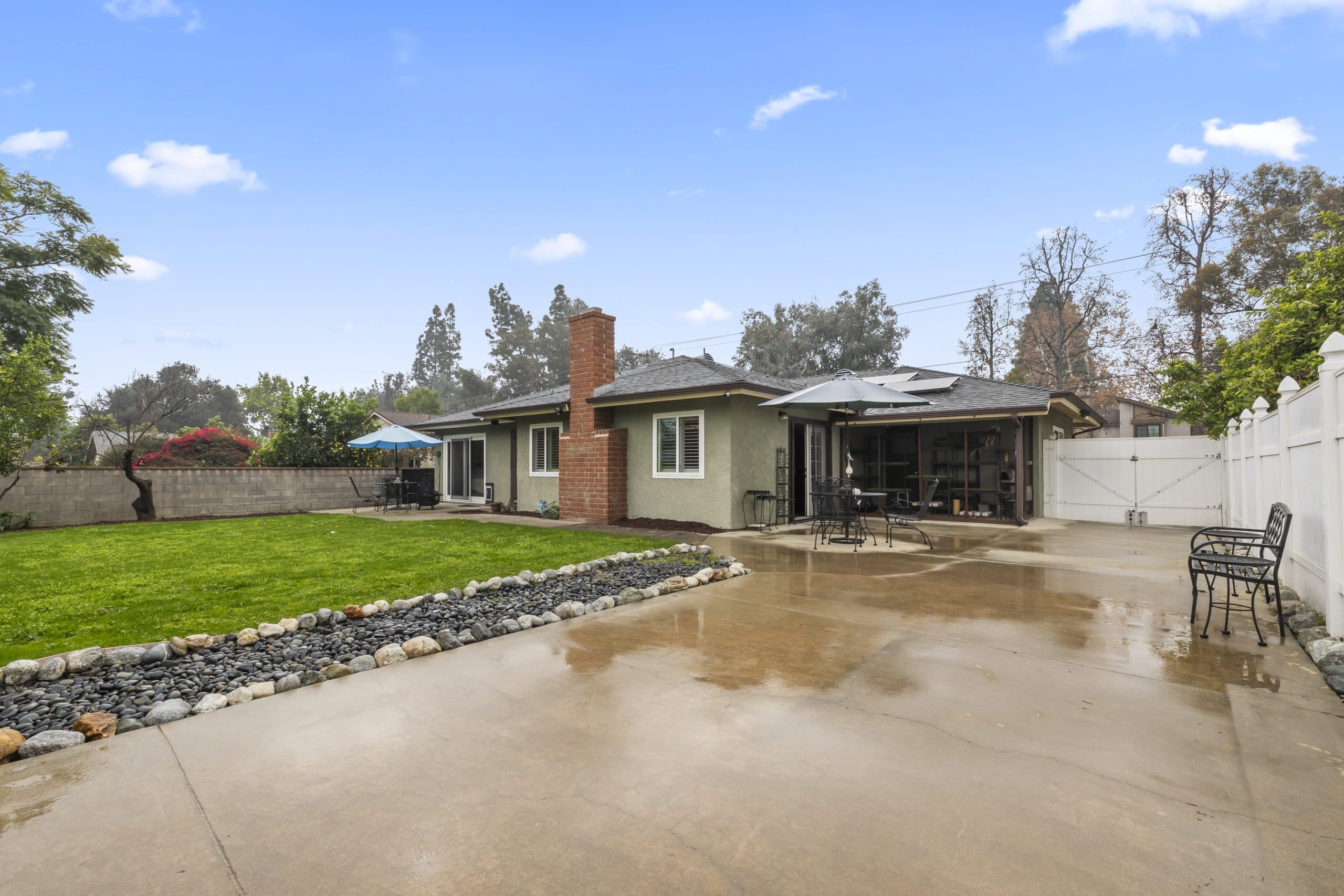
Claremont has a linear open corridor running along its northern flank, following a drainage alignment with a maintained path beside it. Properties that back onto or sit near the Thompson Creek Trail form a distinctive group in this market — they get a permanent green edge that is neither a neighbor nor a wilderness boundary, which is a genuinely different condition from either. This page is about what that edge actually gives and asks. The town-wide map is in the Claremont luxury neighborhoods guide.
Why a linear corridor is its own product
A property can back onto three broad things in north Claremont: another house, open wilderness, or a maintained corridor. Each behaves differently and the corridor is the least understood.
Backing onto HOUSES means neighbors, windows, and the ordinary negotiation of two adjacent yards.
Backing onto WILDERNESS means permanence and quiet with a maintenance obligation attached, which is the subject of the trail-edge guide.
Backing onto a MAINTAINED CORRIDOR is a hybrid. The land behind you is not going to be built on, which is the main thing. But it is also PUBLIC and USED — people walk, run, and ride along it through the day. You gain a permanent green outlook and lose the assumption that nobody is ever behind your fence.
What the corridor gives
PERMANENCE OF OUTLOOK. A drainage alignment with a public path on it is not a development parcel. Whatever the specific ownership and jurisdiction — which is worth confirming for any particular stretch — the practical result is a rear boundary that stays open. That is the most durable amenity a lot can have, and it is why the parcels along it read as larger than their recorded area.
LIGHT AND AIR. A gap behind a row of houses changes the whole rear condition: more sky, more air movement, more distance before the eye hits something built. Rear rooms feel different.
CANOPY BORROWED FROM THE CORRIDOR. Trees and planting along the alignment are not on your parcel and not your maintenance, but they are in your view. That is a good arrangement.
ACCESS TO A CONTINUOUS ROUTE. Being able to step out and be on a maintained path is a real amenity for a household that uses it, and it is one of the few Claremont conveniences that does not require driving.
What it asks
REAR PRIVACY BECOMES A DESIGN PROBLEM. On a corridor lot, the rear boundary faces a used route, which is the opposite of the usual assumption that back yards are the private side. Handling this well is mostly about layered planting and grade rather than fence height, and the technique matters — a solid fence with nothing in front of it reads as a wall to the path and gives you less real privacy than a properly built screening layer. The methods are in the privacy screening guide.
SOUND FROM A DIFFERENT DIRECTION. Not traffic — conversation, dogs, bicycles. It is intermittent and generally light, but it is there, and it is worth standing in the rear yard at a busy hour before deciding how you feel about it.
DRAINAGE ADJACENCY. A corridor following a drainage alignment carries water during storms, and parcels beside it should be understood in that context. What the ground does in a heavy rain, whether there is a defined channel, how the rear of the lot drains, and what agency maintains the alignment are all specific questions with specific answers. Ask the City of Claremont, and check the transaction's natural hazard disclosure for what it says about the property.
BOUNDARY CLARITY. Where a parcel meets public or agency-held land, the exact line and any easements matter more than usual. Encroachments — a fence, a shed, a planting bed placed over the line years ago — are not rare on these boundaries and are far easier to resolve before a purchase than after. A survey is worth considering.
The streets near the corridor, not on it
Not every property that benefits from the corridor backs onto it. The streets a block away get much of the light, the route access, and the sense of an open northern edge, without the rear-privacy question or the boundary complications. For many buyers that is the better position, and it is systematically overlooked because it does not carry the descriptive advantage of directly adjoining.
This is a specific case of a general pattern in Claremont — good ground that no search term points at — covered in the in-between streets guide.
How to evaluate a corridor-adjacent property
WALK THE PATH BEHIND IT, both directions, for several minutes each way. You will learn immediately how visible the rear yard is, how much of the house can be seen, and how the screening actually performs from the outside. Almost nobody does this and it is the single most informative thing available.
DO IT TWICE, at a quiet hour and a busy one. Usage on a maintained route is not constant.
LOOK AT THE GRADE. A house sitting above the corridor is not overlooked at all. A house level with it or below is a different proposition and needs its screening to work harder.
CHECK THE FENCE LINE AND WHAT IS PLANTED IN FRONT OF IT, on both sides. A mature evergreen layer on the corridor side that is not yours is an asset you do not control.
ASK WHO MAINTAINS THE CORRIDOR and on what schedule. Vegetation management along the alignment affects your outlook and your privacy, and knowing which agency handles it tells you who to call.
Where to go next
For the full map of the northern tier and how the corridor relates to the named pockets, see the neighborhood atlas. Anthony Grynchal has been licensed in California since November 2009.
Frequently asked questions
How is backing onto a trail corridor different from backing onto open space?
Both give a permanent open outlook, but a maintained corridor is public and used. You gain light, air and a green edge that will not be built on, and you give up the assumption that nobody is ever behind your fence.
What is the main design challenge on a trail-adjacent lot?
Rear privacy, because the back boundary faces a used route rather than another yard. Layered planting and grade handle it better than fence height alone, and a solid fence with nothing in front of it performs worse than a proper screening layer.
Should I worry about drainage next to the corridor?
It is a question to ask rather than a problem to assume. A corridor following a drainage alignment carries water in storms. Confirm with the City of Claremont how the alignment functions and who maintains it, and read the natural hazard disclosure for the property.
What is the best way to assess one of these properties?
Walk the path behind it in both directions, once at a quiet hour and once at a busy one. You will see exactly how visible the rear yard is and how the existing screening performs from the outside, which no showing will show you.

Written by
Anthony Grynchal
Anthony Grynchal is a California real estate professional with eXp Realty, licensed since November 2009 (California DRE# 01873626), and the Designated Local Expert™ for Claremont — where he has lived for more than 33 years.
More about AnthonyPublished · Updated