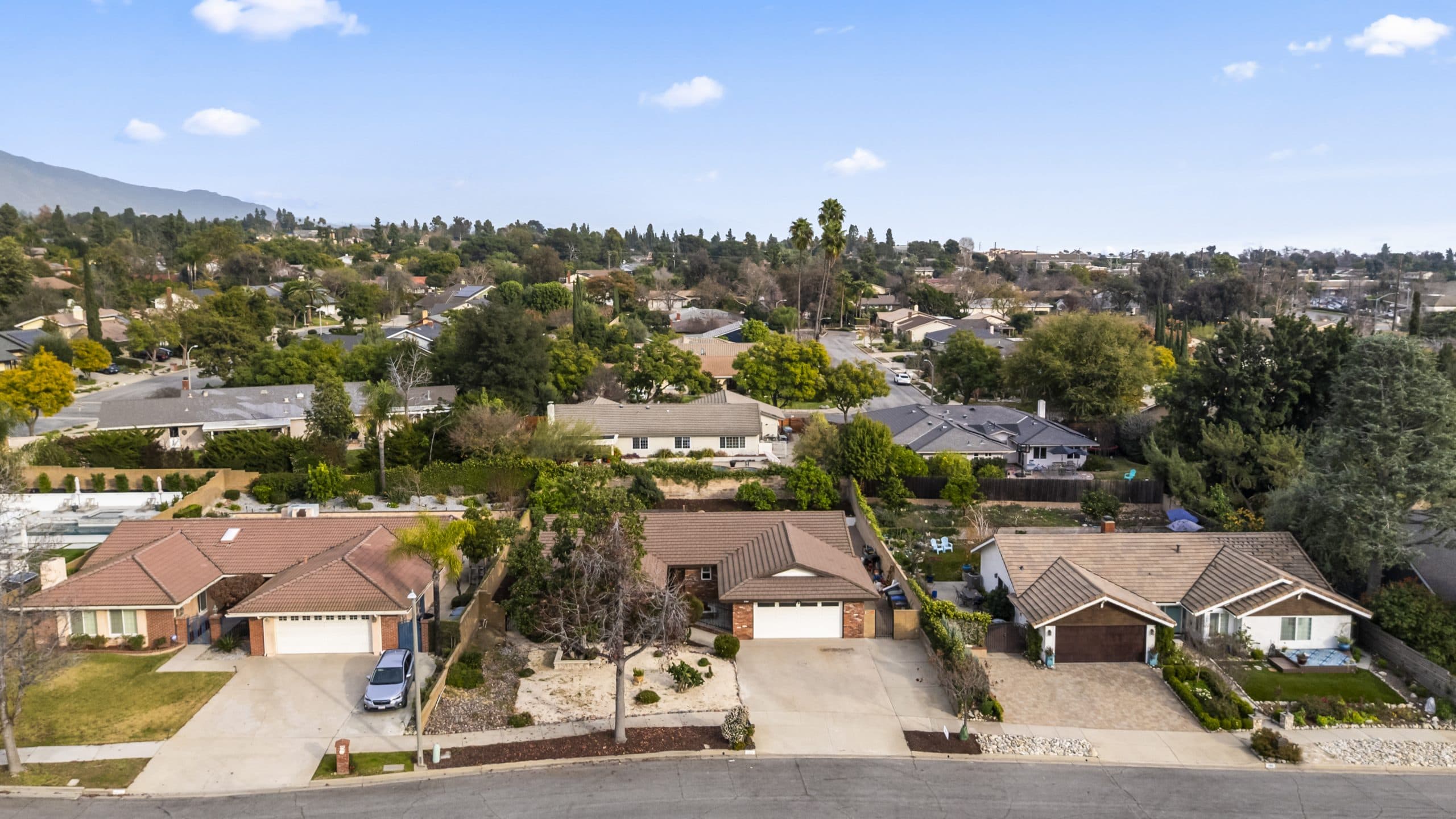
A roof is not one product. It is an assembly, and most of what fails on a Claremont house fails at the joints rather than in the middle of the field.
Owners tend to ask a single question about a roof: how much life is left. That question is unanswerable from the ground and unanswerable from a calendar. What an owner CAN do is learn to read the assembly, notice the signals early, and hand a roofer a useful description instead of a guess. This piece adds the roof layer to the Claremont home maintenance guide.
The parts of the assembly
Underneath whatever you see from the street, a roof is a stack. There is a structural deck. There is an underlayment over it. There is a covering on top of that. And there is a set of metal details - flashing - wherever the covering meets something that is not covering.
Those metal details are the point. Valleys, chimney bases, wall intersections, skylight curbs, vent collars and edge metal are where nearly all roof water intrusion begins. A covering can look tired and still shed water. A failed flashing at a wall junction can leak while every surrounding surface looks new.
When you inspect, or when you read an inspector's report, sort the findings into those two buckets: field condition and detail condition. They lead to different work and different urgency.
What the common coverings do here
Claremont's housing stock carries several covering types, and each ages in a recognizable way under strong sun.
Composition shingle. Look for granule loss, which shows up as bare dark patches on the shingle face and as accumulated grit in gutters and at downspout outlets. Look for edges that have curled up or cupped, and for shingles that have gone brittle enough to crack rather than flex.
Concrete or clay tile. The tile itself is durable; the underlayment beneath it is the part that ages, and it is invisible from outside. Signs worth noting are cracked or slipped tiles, tiles that rock underfoot, and debris packed into the pans. A tile roof can need an underlayment replacement while the tiles themselves are reusable.
Wood shake. Splitting, cupping, moss or lichen colonies on the shaded slopes, and missing pieces are the visible signals. Fire performance is a separate and serious conversation on the north side of town.
Low-slope and flat sections. Many Claremont houses have a flat porch, addition or patio-cover section tied into a pitched main roof. Look for ponding that persists after the surface elsewhere is dry, for blisters, and for seams that have opened. Flat sections and the transitions into them are a common leak source.
The signals you can see without climbing
Stay off the roof. Tile cracks under foot traffic, aged composition tears, and a fall from a single-story eave is still a fall. Nearly everything worth knowing is visible from the ground with binoculars, from a window on an upper floor, or from inside the attic.
From the ground, scan the roof planes for lines that are not straight. A sag along a ridge or a dip in a plane suggests a deck or framing issue rather than a covering issue. Look at the edges: fascia staining, rusted or missing drip edge, and gutters pulling away from the roof line.
Look at every vertical thing that pokes through - vent pipes, chimneys, skylights, mechanical curbs - and at where the roof meets a wall. Those are the flashings.
From inside the attic, on a bright day with the lights off, look for daylight at penetrations. Then look for stains on the underside of the sheathing, for rust on nail points, and for insulation that is matted or discolored in a patch. Water stains have a shape; a rounded ring with a defined edge is usually an old event, and a soft dark area is more likely active. The attic reading also depends on airflow, which is why the attic ventilation guide belongs beside this one.
The drainage half of the problem
Half of what gets blamed on a roof is actually a drainage failure. Water that leaves the covering correctly and then backs up at a clogged gutter, or overshoots a gutter and drops against the foundation, causes damage the roof never caused.
Check that gutters are still pitched toward outlets, that outlets are open, and that downspouts discharge away from the building rather than into the planting bed against the wall. Sizing, slope and the details around them sit in the gutters and downspouts guide, and where that water goes after it lands is the subject of the drainage guide.
What the canopy does
Claremont has a mature tree canopy, and it interacts with roofs constantly. Overhanging limbs abrade coverings in wind, drop debris that dams valleys and gutters, and keep slopes shaded and damp enough for moss and lichen to establish.
Debris in a valley is a specific hazard because a valley is a concentrated flow path. A packed valley turns into a dam, and water that stands against a flashing eventually finds the lap. Managing that relationship is covered in the canopy guide.
Repair, overlay, or replace
Those are the three roads, and the choice is not the owner's alone to make.
A repair is right when the field is sound and a specific detail has failed. A flashing rebuild at a chimney or a wall intersection is a legitimate, targeted fix, and it does not commit you to anything larger.
An overlay - new covering installed over the old - is sometimes possible and sometimes not, and the constraints are structural and regulatory rather than aesthetic. Deck condition, existing layer count and code all bear on it.
A replacement is the answer when the deck or underlayment is the problem, when the field has failed broadly, or when repeated repairs have stopped holding. This is also the moment to make the choices you cannot make later: covering type, ventilation, edge metal, and any fire-performance upgrades.
Roof assembly work is licensed trade work. Structure, fire rating and permitting are involved, so the decision belongs with a licensed roofing contractor, and permitting questions go to the City of Claremont.
Documenting what you find
Photograph what you see, dated, from the same vantage points each time. A photo series is the only honest way to tell whether a crack is moving or a stain is growing, and it is the difference between a mark on the ceiling and a description a roofer can act on.
Keep the roof documents together: the invoice from the last work, any warranty paperwork, the covering type and color, and the permit record if one exists. That file is worth real money at resale, and it is also what stops a future owner from replacing a roof that did not need replacing.
The bottom line
Read the roof as an assembly. Watch the flashings, not just the field. Look for lines that are not straight, stains in the attic, and grit in the gutters. Keep the drainage clear and the canopy off the surface. Then bring a licensed roofer specific observations rather than a vague worry.
For the wider system, start at the owner's guide. This is general information rather than roofing, structural or engineering advice; a licensed professional evaluating your actual roof governs. Anthony Grynchal has been licensed in California since November 2009.
Frequently asked questions
Can I tell how much life is left in a Claremont roof from the ground?
Not reliably. What you can read from the ground is condition: granule loss, curled or cracked pieces, slipped tiles, sagging lines, and the state of the flashings and gutters. Remaining service life depends on the underlayment and deck, which are not visible from outside, so that judgment belongs to a licensed roofer who can inspect the assembly.
Where do most roof leaks in Claremont homes actually start?
At the details rather than in the open field. Valleys, chimney bases, wall intersections, skylight curbs, vent collars and edge metal are the usual origins, along with flat or low-slope sections and the transitions into them. A covering can look worn and still shed water while a single failed flashing leaks.
Should I walk on my roof to inspect it?
No. Tile cracks under foot traffic, aged composition tears, and falls happen from single-story eaves. Inspect with binoculars from the ground, from upper windows, and from inside the attic looking for daylight at penetrations and stains on the sheathing. Leave anything requiring roof access to a licensed roofing contractor.
Do I need a permit for roof work in Claremont?
Roof assembly work commonly involves permitting, and the requirements depend on the scope, the covering and the structure. Confirm with the City of Claremont before work begins, and have your licensed roofing contractor pull what is required rather than assuming a repair is exempt.

Written by
Anthony Grynchal
Anthony Grynchal is a California real estate professional with eXp Realty, licensed since November 2009 (California DRE# 01873626), and the Designated Local Expert™ for Claremont — where he has lived for more than 33 years.
More about AnthonyPublished · Updated