The single most underrated room in a Claremont house has no roof. For a long stretch of the year the outdoor table is where the household eats, and a house that gets this right feels considerably larger than its square footage.
Getting it right is mostly about SHADE and ORIENTATION, and both are visible at a showing if you know when to look.
The hour that decides it
The relevant question is not whether a patio is pleasant. It is whether it is pleasant between roughly five and eight in the evening, because that is when a household eats outdoors.
A west-facing patio takes the full low sun in exactly that window. It can be beautiful in April and unusable in August without something overhead or something planted. A north or east side stays comfortable much earlier and is the reliable option, though it also goes cool sooner in the year.
So the test is simple and almost nobody performs it: stand on the patio at six in the evening. Not at eleven in the morning when the showing is scheduled. If you cannot, look at where the shadows fall, look at what is planted on the west side, and look at the wall behind the patio, because a light masonry wall in the sun radiates heat well after sundown.
Shade you own versus shade you borrow
Three kinds of shade, and they behave very differently.
- BUILT shade: a covered porch, an overhang, a solid patio cover. Predictable, permanent, and it works from day one. It also darkens the rooms behind it, which matters on a house that is already short of light.
- PLANTED shade: a mature tree in the right place. The best version of all of these and the slowest to replace. A patio shaded by a large canopy is a genuinely different room from the same slab in the open.
- BORROWED shade: a neighbor's tree, or the shadow of the house next door. Free, effective, and outside your control. Fine to enjoy, unwise to buy on.
The distinction matters when a tree comes down in a blow, which happens, and the wind-season guide covers what those nights do to a mature canopy. Losing a shade tree can change how a house is used for a decade.
Getting food out there
The patio that gets used is the one closest to the kitchen. This sounds obvious and it is routinely ignored.
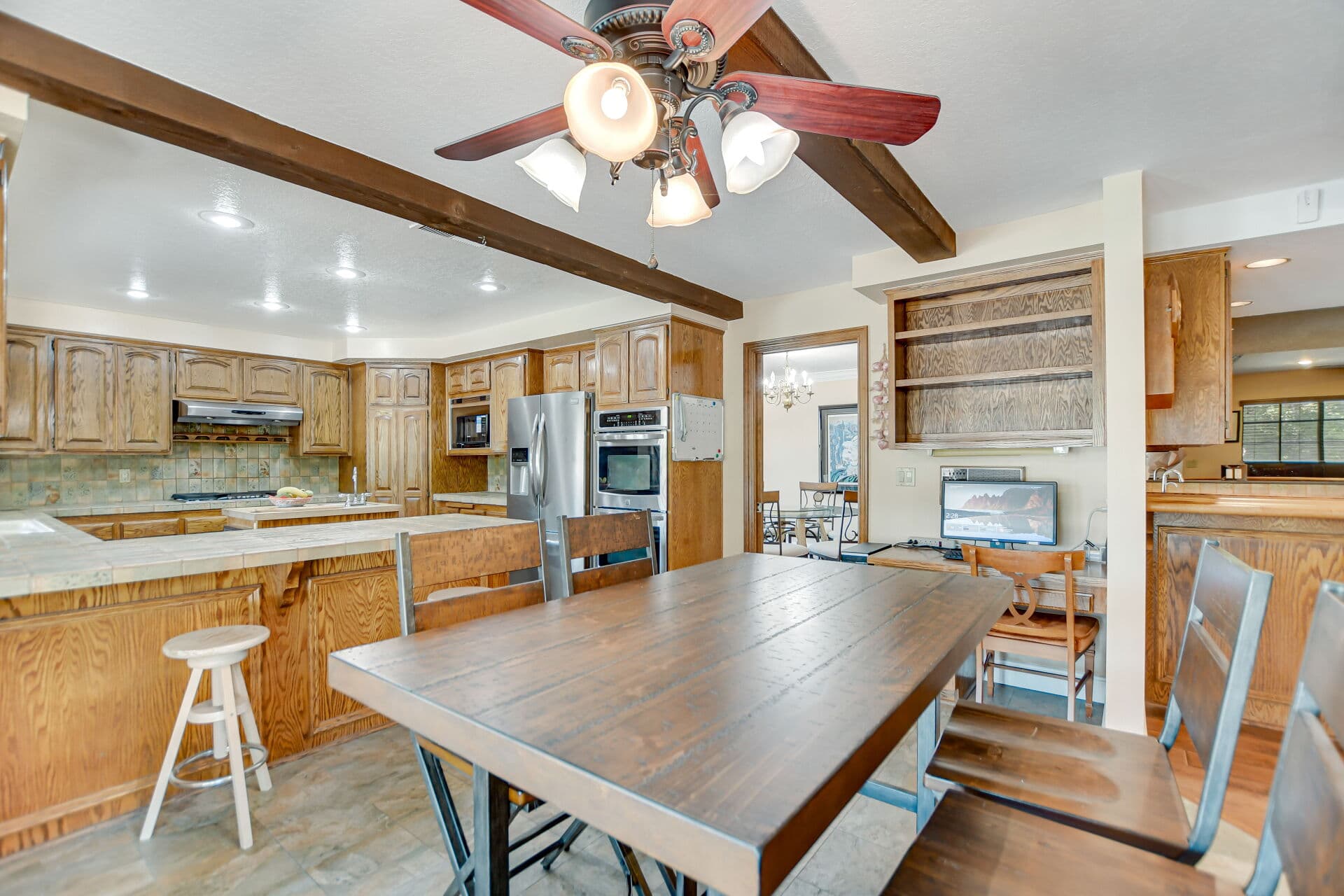
Count the steps and the doors between the range and the outdoor table. Two doors and a level change is enough friction to keep the table empty on a weeknight, no matter how nice it is. One door directly off the kitchen and a flush threshold is the arrangement that converts a patio from a weekend feature to a daily room.
In older Claremont houses the kitchen is usually at the back already, which helps, but the back door is often narrow and there is often a step down to grade. Both are fixable, and both are worth noticing before you assume the outdoor life is included. The rest of that room's constraints are in the older-kitchen guide.
Light, bugs, and the second half of the evening
A patio that works at seven often empties at eight for two reasons, and both are cheap to solve.
The first is light. A single bright fixture on the wall makes a table feel like a loading dock. Low, warm, multiple sources make people stay. Keep it modest for the neighbors as well as yourself, since a bright fixture on a small lot is somebody else's bedroom window. The night guide covers what light spill does on close lots.
The second is that evenings here cool down faster than people expect once the sun is fully off the yard. A wall that holds warmth, a blanket in a basket, or a spot tucked against the house rather than out in the middle of the lawn all extend the season by weeks at either end.
Privacy at table height
The thing to check is not whether the yard is private. It is whether it is private WHEN YOU ARE SEATED, because that is the only sightline that matters at dinner.
Sit down on the patio and look around. A fence that screens you standing up may leave a second-storey window opposite looking straight into the table. Screening at that height is usually a planting problem rather than a fence problem, and the privacy guide covers the geometry.
Surfaces and what they cost you
A patio surface is a maintenance decision as much as an aesthetic one.
Concrete is honest, hot in direct sun, and lasts. Pavers move over time and pick up growth in the joints. Decomposed granite is comfortable and migrates into the house on everybody's shoes, which puts it back into the transition-zone problem. Wood decking under a canopy stays damp longer than people expect and drops leaf litter into the gaps.
None of these is wrong. The point is to know which one you are buying and what it will ask of you seasonally, which is the same calculus as the rest of the lot in the yard-calendar guide.
The checklist
- Which direction does the patio face, and what shades it at six in the evening?
- Is the shade built, planted, or borrowed?
- How many doors and steps between the range and the table?
- Is there a hose bib and an outlet within reach?
- Sitting down, who can see you?
- Where does the table go when it rains, and where does it go in August?
Where to go next
The whole set is indexed at the lifestyle guide, and the natural companion is the hosting guide, since for most of the year the outdoor table is where hosting actually happens. For whether a specific patio works at the hour you would use it, stand on it at that hour. Anthony Grynchal has been licensed in California since November 2009.
Frequently asked questions
What is the most important thing to check about a patio here?
What shades it between roughly five and eight in the evening, because that is when a household eats outside. A west-facing slab with no cover takes the full low sun in exactly that window. Visit at that hour if you can, or read the shadows and the planting on the west side.
Why does the distance from the kitchen matter so much?
Because friction decides whether a patio is a daily room or a weekend feature. Two doors and a level change between the range and the table is usually enough to keep it empty on a weeknight. One door off the kitchen with a flush threshold is what makes it get used.
What is the difference between planted, built, and borrowed shade?
Built shade is permanent and predictable but darkens the rooms behind it. Planted shade is the best version and the slowest to replace, so losing a mature tree changes how the house is used for years. Borrowed shade from a neighbor's tree is pleasant but outside your control, so do not buy on it.
How do you judge patio privacy properly?
Sit down first. A fence that screens you standing may leave a second-storey window opposite looking straight at the table. Privacy at seated height is usually solved with planting rather than fencing, and that is the only sightline that matters at dinner.

Written by
Anthony Grynchal
Anthony Grynchal is a California real estate professional with eXp Realty, licensed since November 2009 (California DRE# 01873626), and the Designated Local Expert™ for Claremont — where he has lived for more than 33 years.
More about AnthonyPublished · Updated